Articles & Chapters
-
‘The Tension of History: An Interview with Nic Watts and Sakina Karimjee.’ Journal of Graphic Novels & Comics 17.3 (June 2026), pp.668-680. Link.
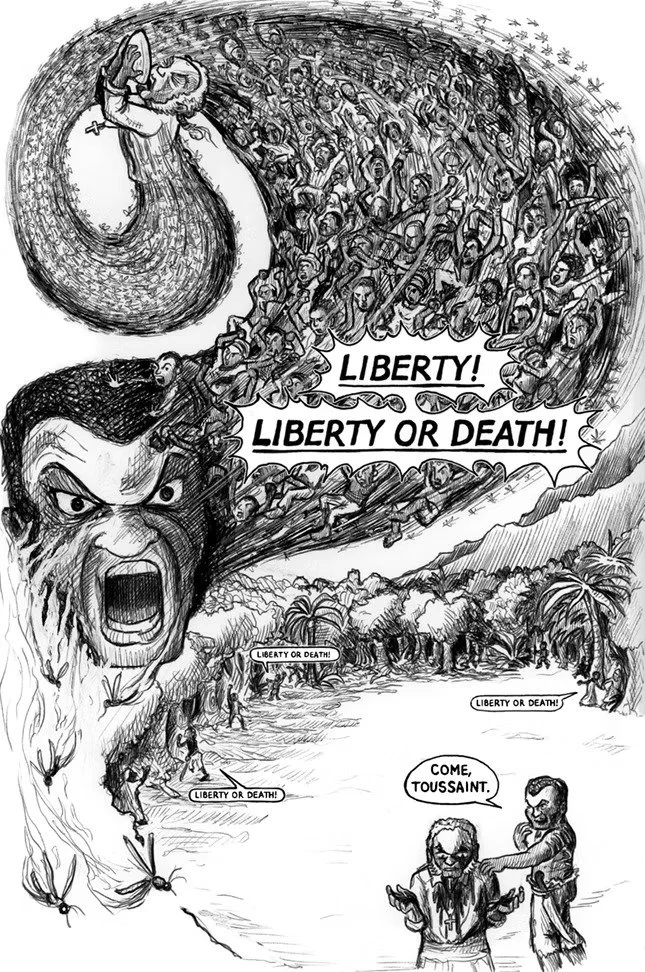
Nic Watts and Sakina Karimjee are the co-creators of Toussaint Louverture: The Story of the Only Successful Slave Revolt in History (2023), a graphic novel adapted from a play by the anti-colonial historian C.L.R. James. It tells the story of the Haitian Revolution (1791–1804) as a slave-led uprising of world-historical significance. This interview provides in-depth discussion of several aspects of the graphic novel, including its origins and inspiration, the parallels between theatre and comics, the use of graphic narrative to picture world-historical events, and the enduring importance of the Haitian Revolution today.
-
‘Sketching Affects: Enacting Human Rights as Relationships.’ Journal of Graphic Novels and Comics. Online first: 16 April 2026.
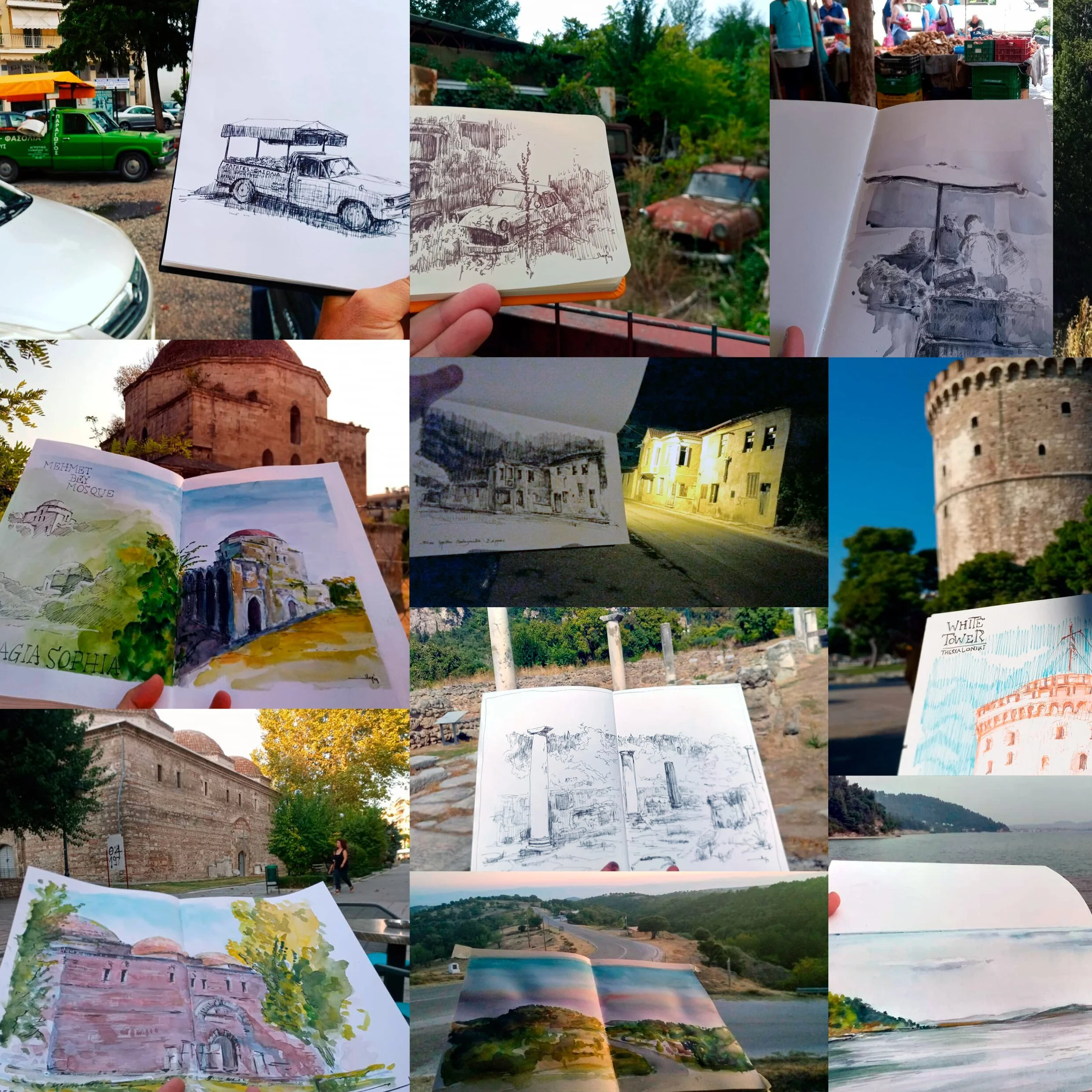
This essay draws on the work of art historian and activist John Berger to explore how sketching and the sketchbook afford an opportunity to rethink human rights as a set of affective relations that are enacted between people regardless of national borders. In its first part, it offers a reading of Berger’s Bento’s Sketchbook (2011), where in dialogue with Spinoza he argues that sketches capture a shared affect between artists and the subjects of their work, whether human subjects or non-human objects. In its second part, the essay brings this idea into conversation with the artist Joss López’s crowd-funded and independently published book of narrative art, Serres: Reportage of a Journey Through Sketching (2022). Presented as a sketchbook and containing images that deliberately perform the aesthetics of the sketch, Serres documents the artist’s experience working together with refugees, volunteers, and support workers in the eponymous Greek city. By combining the Spinozan philosophy of Berger’s Bento’s Sketchbook with an analysis of López’s Serres, the essay argues that sketching points to a radical re-conceptualisation of human rights as enacted relationships between subjects, rather than as a set of individual entitlements that must be granted and recognised by national or supra-national states.
-
‘Power Grids: Community Energy and Comics Co-Creation,’ with Kremena Dimitrova and Reed Puc. Journal of the British Academy 14.1 (2026), pp.1-25.
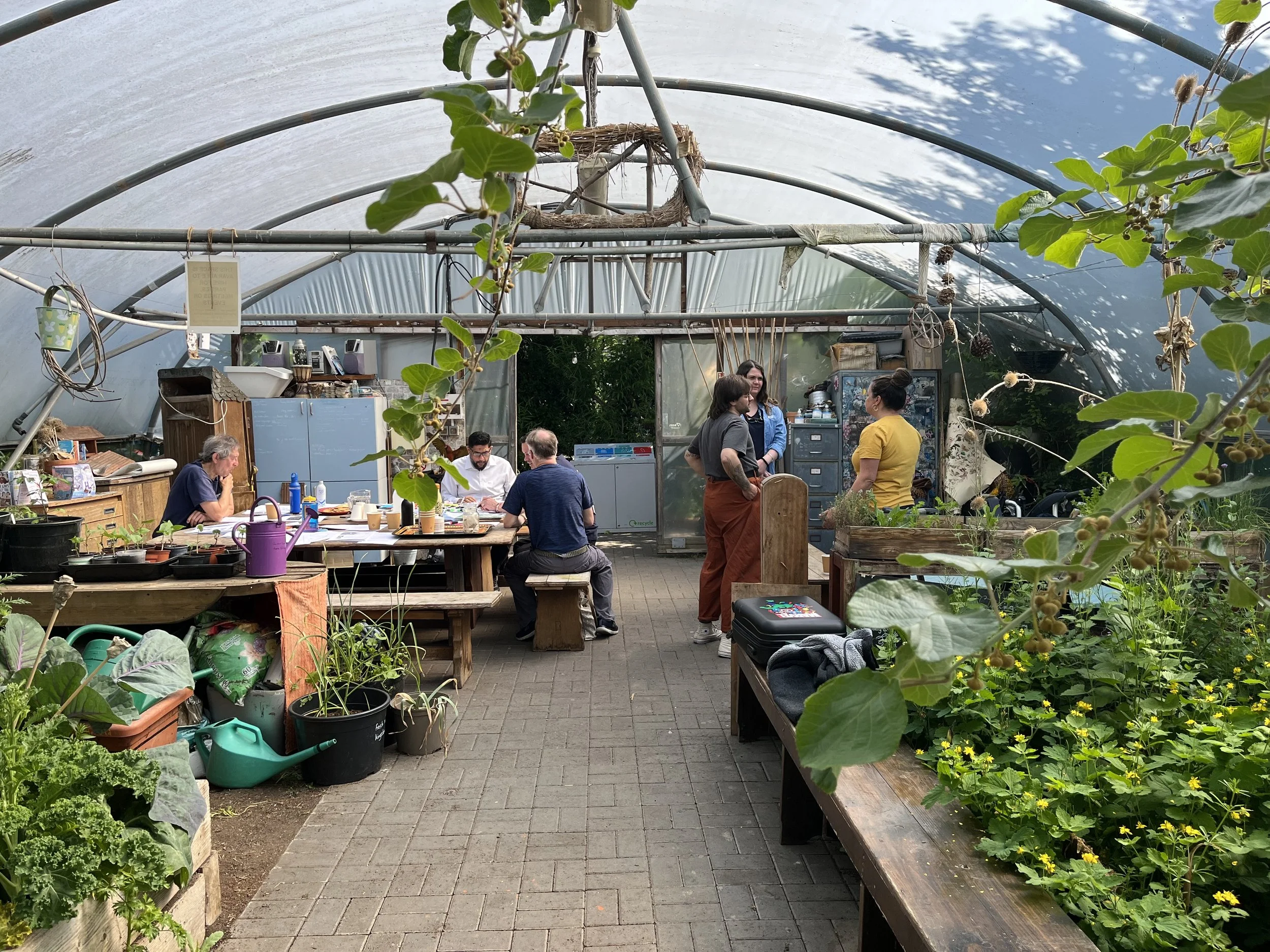
This online exhibition of photographs and artworks provides documentation of ‘Power Grids: Reimagining Energy Infrastructure in Comics’ (2024–2026). The project is funded by the BA/Leverhulme Small Research grant scheme and the images included here were exhibited at the British Academy’s Summer Showcase in June 2025. The project brings together two discrete yet growing social movements: community energy and comics-based research. It uses comics co-creation workshops to conduct research into the way communities across England are organising to produce sustainable energy and in that way to lower fuel costs, catalyse the green transition and combat the climate crisis, and build place-making cultures of empowerment and belonging.
-
‘Unraveling Adventure Fictions: Anti-imperial Connections and Modernist Compressions.’ In Auritro Majumder ed., Cambridge Companion to British Literature & Empire. Cambridge: Cambridge University Press, 2026, pp.189-201.
At the turn of the twentieth century in Britain, genres such as the imperial romance, framed by a white, masculine gaze, expressed an imperial confidence that dovetailed with the jingoistic adventurism of high Empire. But as inter-imperial rivalries intensified and anti-imperialist movements gained momentum, the romance’s generic and formal features were unsettled by a range of modernist techniques. While this is often recognised in stories by writers such as Conrad and Kipling, this chapter traces the modernist compressions and anti-imperial connections that run through the adventure fiction of two very different authors writing between 1900 and 1945: John Buchan, an arch-imperialist and politician whose romances and spy thrillers are warped by the threat of emerging inter-imperial rivalries; and Edward John Thompson, a friend of Gandhi and translator of Tagore whose Indian novels combine the generic residues of the romance with the growing presence of anti-imperial insurgencies. Drawing out these formal compressions with reference to modernist writers such as E.M. Forster, the chapter shows how adventure fictions unraveled through the Empire’s final decades.
-
‘More Broken Promises: The Politics of Infrastructure.’ Soundings: A Journal of Politics and Culture 88 (2024), pp.41-58
Drawing on key arguments from The Broken Promise of Infrastructure one year after its initial publication, this article reflects on the evolving politics of infrastructure in the UK and globally. It begins with the situation in Gaza, arguing that each piece of decimated infrastructure there is a broken promise, a bit of future life that has been deliberately eradicated. It then turns to the UK context, exposing the affective connections between the rentier capitalism that is ruining Britian’s infrastructure and the racist riots that shook the country in August 2024. It argues that the policies of the new Labour government are exacerbating this situation, and that a binary discourse of NIMBY vs YIMBY is part of the problem. In conclusion, it sketches out ways in which the left might begin to mobilise effectively around infrastructure in the political landscape that we now find ourselves in, including through community infrastructure projects.
-
‘The Infrastructure Humanities.’ Interventions: International Journal of Postcolonial Studies 26.8 (2024), pp.1351-1367
It is an exciting time for the infrastructure humanities, with numerous publications, the formation of the UK’s first Infrastructure Humanities Group, and a swell of conferences and panel events on infrastructure appearing in recent years. As infrastructure becomes an increasingly familiar object and method of study in the arts and humanities, this essay reviews three books – two edited collections and one monograph – that were published under the broad umbrella of the infrastructure humanities in 2023. Drawing from these reviews and a series of reflections on the field, the essay offers a sketch of the origins of the infrastructure humanities, a snapshot of current interests and directions, and potential areas for inquiry moving forward.
-
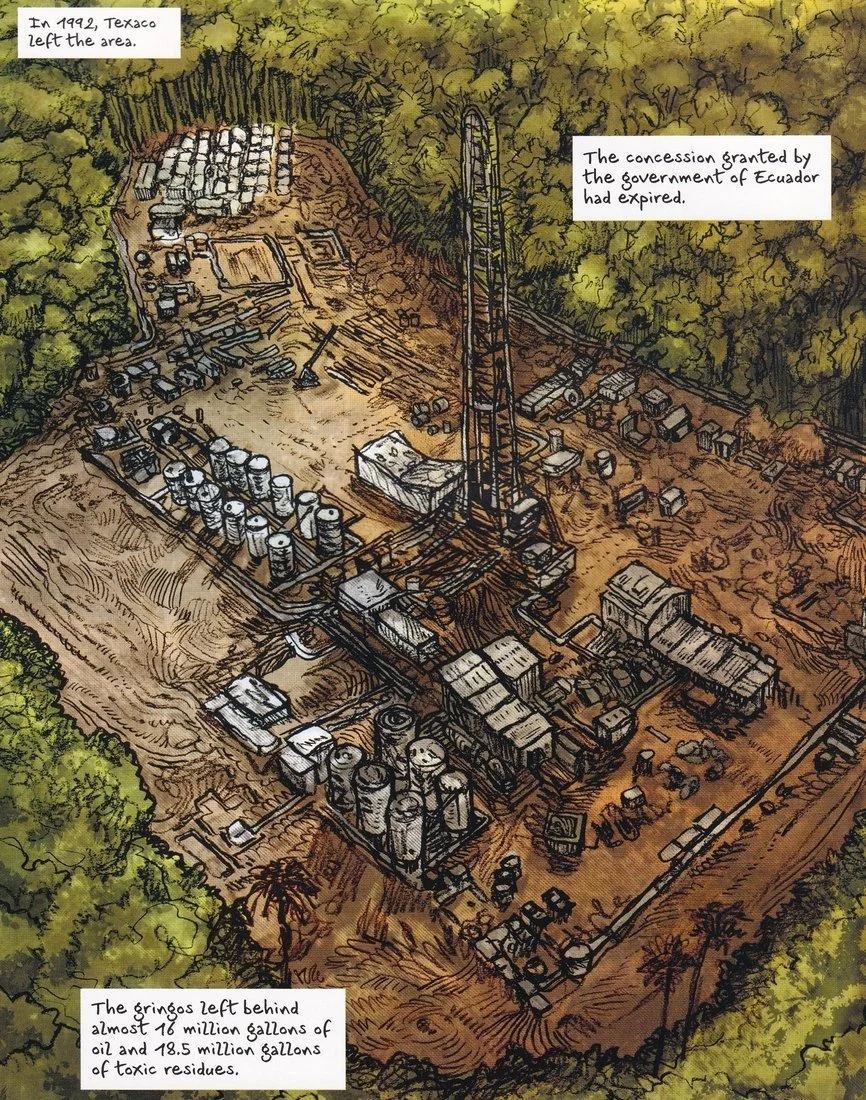
‘Graphic Capitaloscenes: Drawing Infrastructure as Historical Form.’ Critique: Studies in Contemporary Fiction 65.4 (2024), pp.680-695
This article describes “graphic Capitaloscenes” – narrative moments in which graphic novels draw infrastructure as a material expression of capitalism’s historical development. Drawing on work that has described graphic narrative as both an “infrastructural” and “scenographic” form, it contends that graphic novels are particularly adept at representing infrastructure as historical content while themselves materializing that historical infrastructure on the page. Bringing this to bear on visual texts concerned with capitalism’s frontier zones, this article suggests that graphic novels are therefore not only able to stage extractive infrastructures as historical forms, but that they are also themselves formally conjoined to the current historical moment of the Capitalocene. The article offers two case studies, Joe Sacco’s Paying the Land (2020) and Pablo Fajardo’s Crude, A Memoir (2021), to show how these comics are able to stage infrastructure as historical form, while at the same time bringing into view anti-colonial and anti-capitalist relations.
-
’Graphic Borders: Refugee Comics as Migration Literature.’ In Gigi Adair, Rebecca Fasselt, & Carly McLaughlin eds., The Routledge Companion to Migration Literature. New York: Routledge, 2024, pp.280-291
What does it mean to draw a refugee? Why have so many artists sought to tell migrant stories through hand-drawn images in recent years? Why are these drawings or paintings of refugees so often arranged into a sequential order—what we might refer to as “sequential art,” “graphic narratives,” or even “comics”? What are the affordances and politics of these “refugee comics”? Who makes them? Where are they published and how are they read? And what kinds of artistic and narrative techniques have they developed to address the complex representational, political, and cultural questions that structure the relationship between readers and refugees? These are some of the questions addressed in this chapter. Through multiple examples from a range of different genres, forms, and platforms, it aims to give a broad introduction to refugee comics as a substantive and growing contribution to literatures of migration.
-
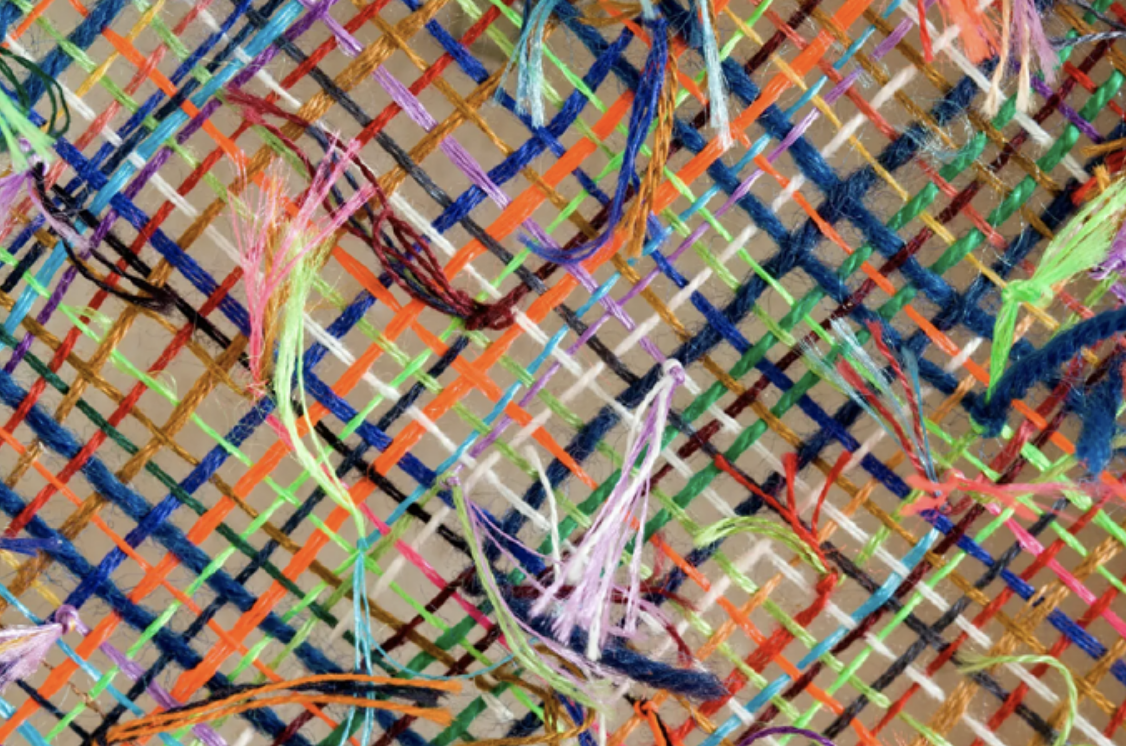
‘Queering the Line.’ Roadsides, Collection No.9: Gendering Infrastructure (April 2023), pp.65-71
This essay argues that capital’s economic ideal of the ‘straight’ infrastructural line does not simply echo heteronormative and patriarchal ideals, but actively concretizes them into the world. It produces and reproduces social relations, contends Tim Ingold (2007: 4), its “straightness” epitomizing “not only rational thought and disputation but also the values of civility and moral rectitude.” By queering the straight line, I refute this ‘rational’ ideal and show instead how it blends together systems of patriarchy and accumulation. To avoid straightness in my own line of argumentation, I approach this topic from three different directions. Each section begins with an image and statement about the straight line, which it then deconstructs and disorganizes. The aim is to weave together a cross-hatched argument, rather than marching a masculine line through the empty page.
-
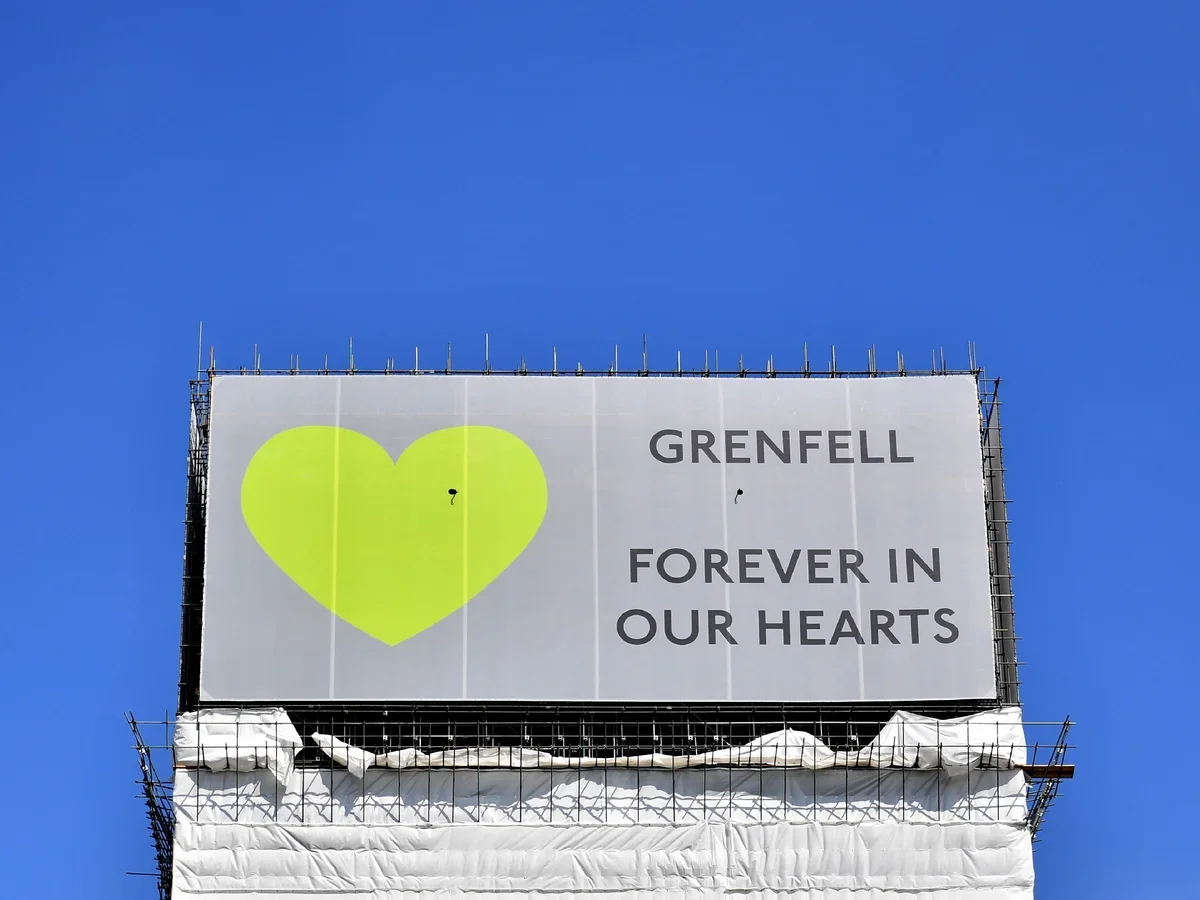
‘The City of the Missing: Poetic Responses to the Grenfell Fire.’ Journal of Urban History 49.3 (April 2023), pp.584-599
This essay is about the representation and recognition of the victims and survivors of the Grenfell fire disaster in poetry written since June 14, 2017. It begins by arguing that the fire was caused not by a lack of knowledge, but by a refusal to acknowledge the voices of the community. It shows how this refusal of recognition was both direct and systemic, slow and immediate, situating the fire in the recent and long-term contexts of austerity and the hostile environment, the demonization of social housing, urbanization and the rise of slums, and the logics of colonialism and racial capitalism. The essay then turns a series of poetic responses to the fire, read and discussed mostly in the order of their publication. These include poems by Ben Okri, Roger Robinson, and Jay Bernard; spoken word performances by Potent Whisper; and two tracks by Lowkey. Through close and careful readings of this work, the essay identifies a hauntological politics of acknowledgment and memorialization that refuses social death and galvanizes social life.
-
‘Beyond Experience: The Rise of Anti-Racist Non-Fiction.’ In Emma Parker, Joshua Doble, & Liam Liburd eds., British Culture After Empire: The Contested History of Decolonisation, Migration, and Race in Modern Britain. Manchester: Manchester University Press, 2023, pp.87-105
In Britain, the ‘anti-racist non-fiction’ genre blends memoir with social and historical commentary to build similar connections between individual experiences and structural conditions, often (though not always) without conforming to the individualising inclinations of identity politics that are otherwise so pervasive in our neoliberal era. My aim in this chapter is to explore how this process in two of the most rigorous and best-selling of Britain’s anti-racist non-fiction titles. I look first at Eddo- Lodge’s Why I’m No Longer Talking to White People about Race (2017) and discuss its implications for anti-racist work. I reflect on the importance of experience to analyses of institutional racism and undermine the rhetorical separation of ‘academic’ writing from individual biography.
-
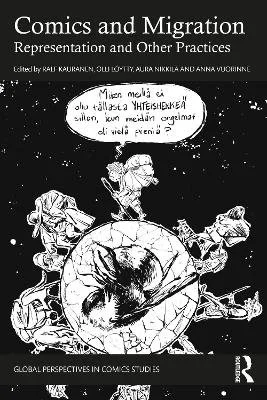
‘Intolerable Fictions: Composing Refugee Realities in Comics.’ In Ralf Kauranen, Olli Löytty, Aura Nikkilä, & Anna Vuorine eds. Comics & Migration: Representation & Other Practices. New York: Routledge, 2023, pp.257-270
In this chapter I argue that we must unsettle two common misconceptions. First is the notion that in our digitised visual culture there are “too many images” of refugees specifically, and of war and displaced people generally. Against this assumption, I would argue that there are not “too many” of these images, and that in fact there is a dearth of them. But there are too many images of unnamed refugees, too many photographs of people contained within the frame and subject to the camera’s gaze, yet deprived of access to accompanying explanatory or self-identifying text. The second and related misconception that I argue we should reconsider is the idea that the veracity and verifiable “truth” of the photographic image is in question, and that its political impact has therefore been diminished. We might be better served by questioning whether the underlying premise of this notion – which assumes that there should be a direct line between the singular photograph or image of the refugee, on the one hand, and empathetic feeling or political action on the part of the viewer, on the other – is all that helpful in the first place.
-
With Elleke Boehmer. ‘Empire: The 19th Century Global Novel in English.’ In Joel Evans ed., Globalisation and Literary Studies. Cambridge: Cambridge University Press, 2022, pp.80-93
This chapter addresses the integral role that literary writing in English, and especially the realist novel, played in imaginatively shaping, structuring and on occasion obscuring processes of nineteenth-century globalization, for which empire was the constitutive ground. We will observe how the novel composed what Raymond Williams called ‘structures of feeling’ that combined together human relationships and their wider contexts in communicable ways even when, as here, those contexts extended beyond the nation and took on global dimensions. Throughout, globalization will be taken as the incremental and unequal incorporation of non-capitalist regions of the world into the rising capitalist economies of Europe and then North America, a process accompanied by the uneven imposition of cultural, technological and infrastructural influence. Globalization and empire were therefore folded into one another, taking on different features at their geographic and economic cores and peripheral edges.
-
‘The Precarious Rule of Aesthetics: Form, Informality, Infrastructure.’ In Om Dwivedi ed., Representing Precarity in South Asian Fictions. London & New York: Palgrave MacMillan, 2022, pp.69-86
My central argument in this chapter is that the emergence of a rule by aesthetics in Delhi and India’s other megacities goes some way to explaining a coterminous trend towards the genre of literary non-fiction—as opposed, that is, to creative or literary fiction. Speaking to the concerns of the volume, the two—rule by aesthetics and literary non-fiction—come together and clash especially around their approach to the cities’ most precarious urban dwellers. While I therefore argue that the non-fictional claim of literary non-fiction is often designed to expose India’s ‘world class’ aesthetic as a precarious fiction, I also contend that it more fully upturns this aesthetic to produce the urban precariat and other forms of informality as themselves infrastructural to the cities’ construction and ongoing function.
-
With Benjamin Fraser. ‘Infrastructure and intervention on the comics page: An interview with Dominic Davies about his book Urban Comics (2019).’ Journal of Urban Cultural Studies 9.2 (December 2022), pp.275-283
This interview documents a conversation between two scholars of space and comics. Benjamin Fraser asks Dominic Davies about his recently published book, titled Urban Comics. Conversation ranges from the author's experience connecting the medium of comics and graphic novels with various themes from the geographical and social sciences. Readers are introduced to the general arguments of the book, which are supported with specific quotations from selected chapters. A range of aesthetic and political concerns are discussed, as are various comics creators and their projects.
-
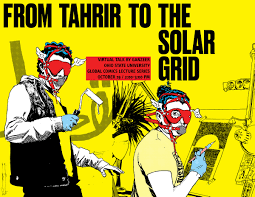
‘Contingent Futures and the Time of Crisis: Ganzeer’s Transmedial Narrative Art.’ Literary Geographies 8.2 (October 2022), pp.154-174
This article explores the work of the Egyptian street artist and graphic novelist, Ganzeer, who describes himself as a ‘contingency artist’. Developing this idea of contingency, the article shows how Ganzeer’s work responds to the time of crisis as something that is narrated and performed, especially in the era of image capitalism. It begins with a discussion of Ganzeer’s use of street art during the Egyptian Revolution, showing how graffiti strategically emphasised the time of crisis as a momentary rupture in order to connect local political movements with a global media and international viewership. The article then turns to a close reading of Ganzeer’s more recent graphic novel, The Solar Grid (2016-present), to show how the medium of comics allows him to construct more elongated narratives in which the time of crisis is modernity itself.
-
‘Infrastructural Forms: Comics, Cities, Conglomerations.’ In Lieven Amiel ed., Routledge Companion to Literary Urban Studies. New York: Routledge, 2022, pp.163-176.
This chapter makes the case for comics as an artistic and narrative form that is particularly capable of capturing the density and dynamism of increasingly global cities, comprising as they both do a complex conglomeration of variously interrelated and unevenly autonomous moving parts. Whether the accumulations of capital that coagulate into points of urban redevelopment and gentrification, for example, or the interstices of slums and favelas that are at different times ignored by and resistant to the state, the unequal spaces of today’s cities are brought into a field of mutual play and narrative position by comics and graphic narratives. Comprising narrative building blocks and an architecture all their own, comics are able to intervene into the sociospatial dialectic of urban life, not only revealing the infrastructure of the city as a material embodiment of competing and often invisible interests but also recalibrating and reconceiving urban space towards more socially and spatially just ends – often from the ground up.
-
‘Pages of Exception: Graphic Reportage as World Literature.’ In James Hodapp ed., Graphic Novels as World Literature. London: Bloomsbury Publishing, 2022, pp.11-31
I argue in this chapter that graphic reportage unsettles both the “world” and “literature” of “World Literature” in productive and pressingly political ways. With their shared inclusion of spaces of exception, the examples of graphic reportage analyzed here join up stories of otherwise disconnected, isolated, and imprisoned people, from the borders of Fortress Europe to the “Jungle” refugee camp in Calais, and from remote refugee detention centers in Canada to the militarized Mexican border city of Juárez. The artists surveyed in this chapter try to communicate stories from places where the rights-based legal fabric of the nation-state system has been cut away, withdrawn, or denied, and where a carceral humanitarianism has arisen in their place.
-
‘The Gutters of History: Geopolitical Pasts and Imperial Presents in Recent Graphic Non-Fiction.’ In Michael Goodrum, David Hall, & Philip Smith eds., Drawing the Past: Comics and the Historical Imagination in the World. Jackson: Mississippi University Press, 2022, pp.56-78
The comics addressed in this chapter offer a contrapuntal reading of the colonial present’s Orientalist rhetoric in order to challenge it, while also challenging a tendency to fetishize the imaginative power of the comics “gutter” in much comics criticism. For it is in a contrapuntal sense that I deploy the phrase included in the title of this chapter, “the gutters of history”: the comics’ gutters materialize contrapuntal geographies and histories spatially on the page, thereby accounting for the historical omissions of the colonial present and reinserting them to effectively challenge the West’s contemporary neo-imperial interference in the Middle East.
-

‘Witnesses, graphic storytellers, activists: an interview with the KADAK collective.’ Journal of Graphic Novels and Comics 12.6 (April 2022), pp.1399-1409
In this interview, several members of the South Asian womxn’s graphic storytelling collective, KADAK, discuss the group’s recent projects, their collaborative production processes, and the themes that are most central to their work. After a brief introduction, the discussion turns to the benefits and difficulties of self-publishing, working online and offline, and nationally and internationally, and the collective’s first book-length, crowd-funded project, The Bystander Anthology, which was published in 2020.
-
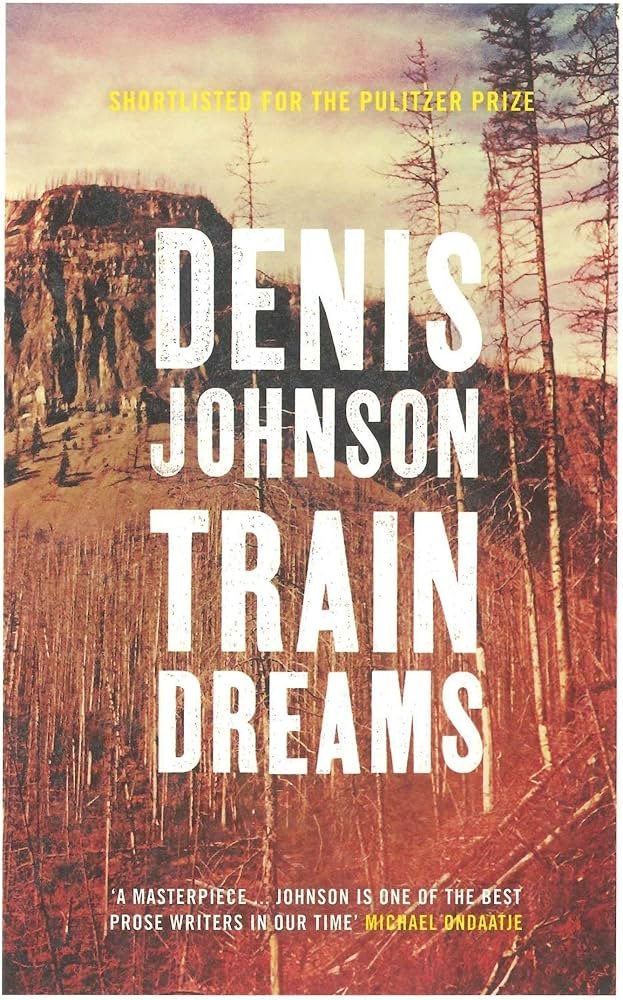
‘Unsettling Frontiers: Property, Empire, and Race in Denis Johnson’s Train Dreams.’ Critique: Studies in Contemporary Fiction 63.4 (August 2022), pp.385-400
This article explores the “unsettling” qualities of American writer Denis Johnson’s 2011 novella, Train Dreams. It explores the book’s engagement with environmental crises and indigenous cosmologies to show how the metaphysical insecurities, common to much of Johnson’s fiction, come in this context to challenge the very concept of American nationhood itself – or as the novella’s title parodies, the “American Dream.” Train Dreams unsettles what I call the narrative infrastructures undergirding the story of the American frontier-becoming-nation-state: the transcontinental railroads, and the colonial property regimes that those railroads both pursued and opened up. In three central sections, the article explores Johnson’s unsettling of notions of property, then empire, and finally race. Through these readings, it shows how the novella finds its way to an indigenous critique of America as a settler-colonial state. While previous critical discussions of the “unsettling” qualities of Johnson’s work have until now meant that word affectively, in this article my aim is therefore to emphasize its decolonizing momentum as well.
-
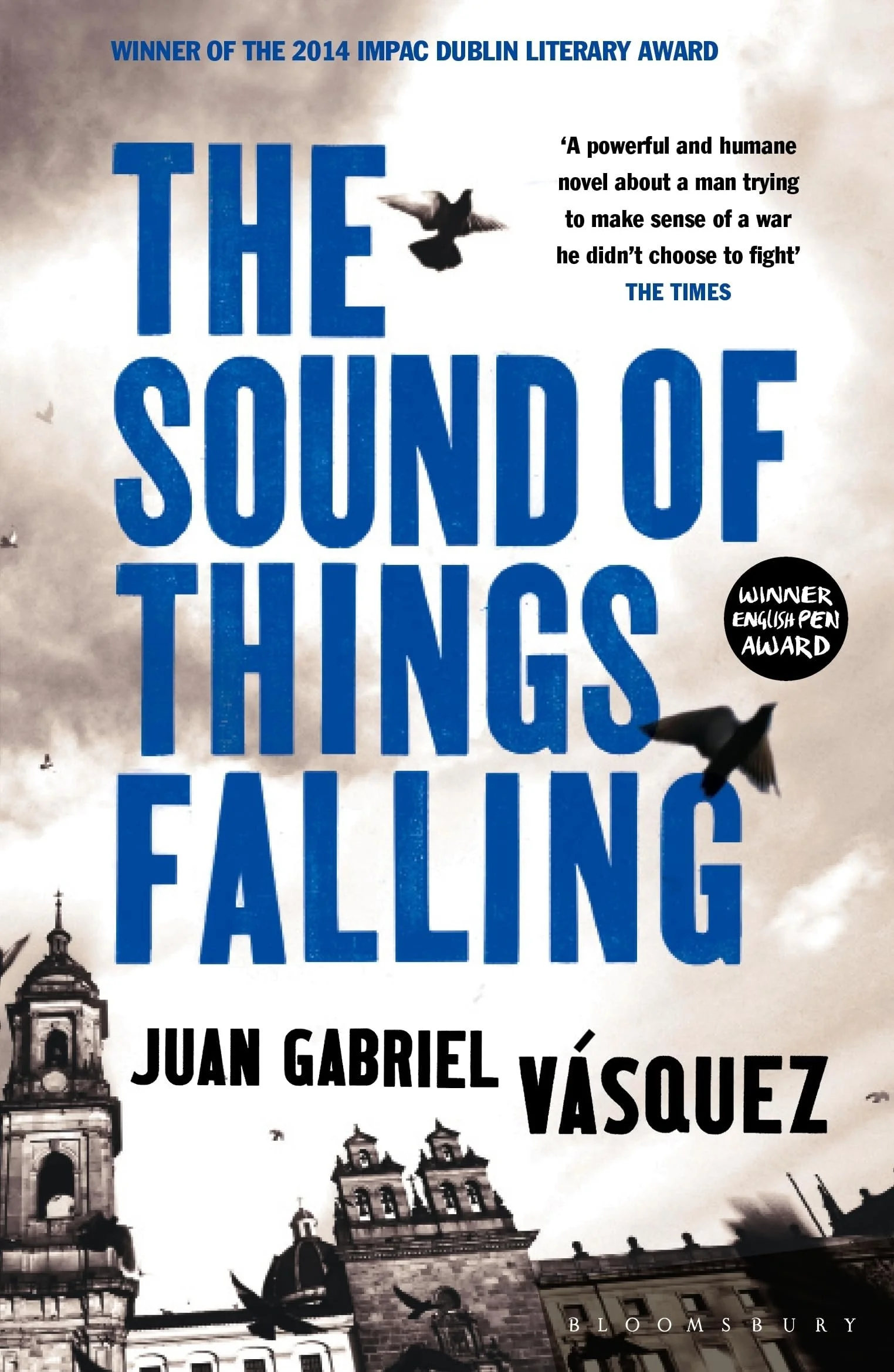
‘All that is solid falls from the sky: Modernity and the Volume of World Literature.’ Cambridge Journal of Postcolonial Literary Inquiry 9.1 (February 2022), pp.1-25
This article pits two conceptions of modernity—that of the Marxist humanist Marshall Berman and the ANT (Actor-Network Theory) sociologist Bruno Latour—against each other, exploring the implications of each for postcolonial and world literary criticism. The article begins by explaining “modernity” in the terms of both theorists, focusing on the “split” between subject and object, text and world. It then offers in turn a Latourian reading and a structural critique of the Colombian novelist Juan Gabriel Vásquez’s fifth novel, The Sound of Things Falling (2011, trans. 2013), probing their possibilities and limitations. In conclusion, it suggests Berman’s more expansive definition of modernist practice as one way in which postcolonial and world literary criticism might more effectively mediate between structural critique and close reading.
-
‘Against the System: Postcolonialism, Humanism, and the Humanities.’ Moving Worlds: A Journal of Transcultural Writings 20.2 (2021), pp.113-128
This essay argues for a postcolonial humanism and a humanist postcolonial studies that is rooted in both the institutional and methodological space of the disciplinary humanities. It argues that for decades two opposing intellectual positions have long been consolidated through the elision of a third: on the one hand, there are the materialists who read the world through an international division of labour, and on the other, the theoretically anti-humanist and poststructuralist postcolonial scholars. Meanwhile, the humanists remain ‘sentimentally’ committed to an underlying universalism, dismissed by postcolonial critics for their essentialism and materialist critics for their liberalism, all in spite of the fact that ‘humanism’ had been a keyword used by leading anti-colonial writers and activists throughout the twentieth-century to summon the sense of collective agency that underpinned mass movements for decolonisation.
-
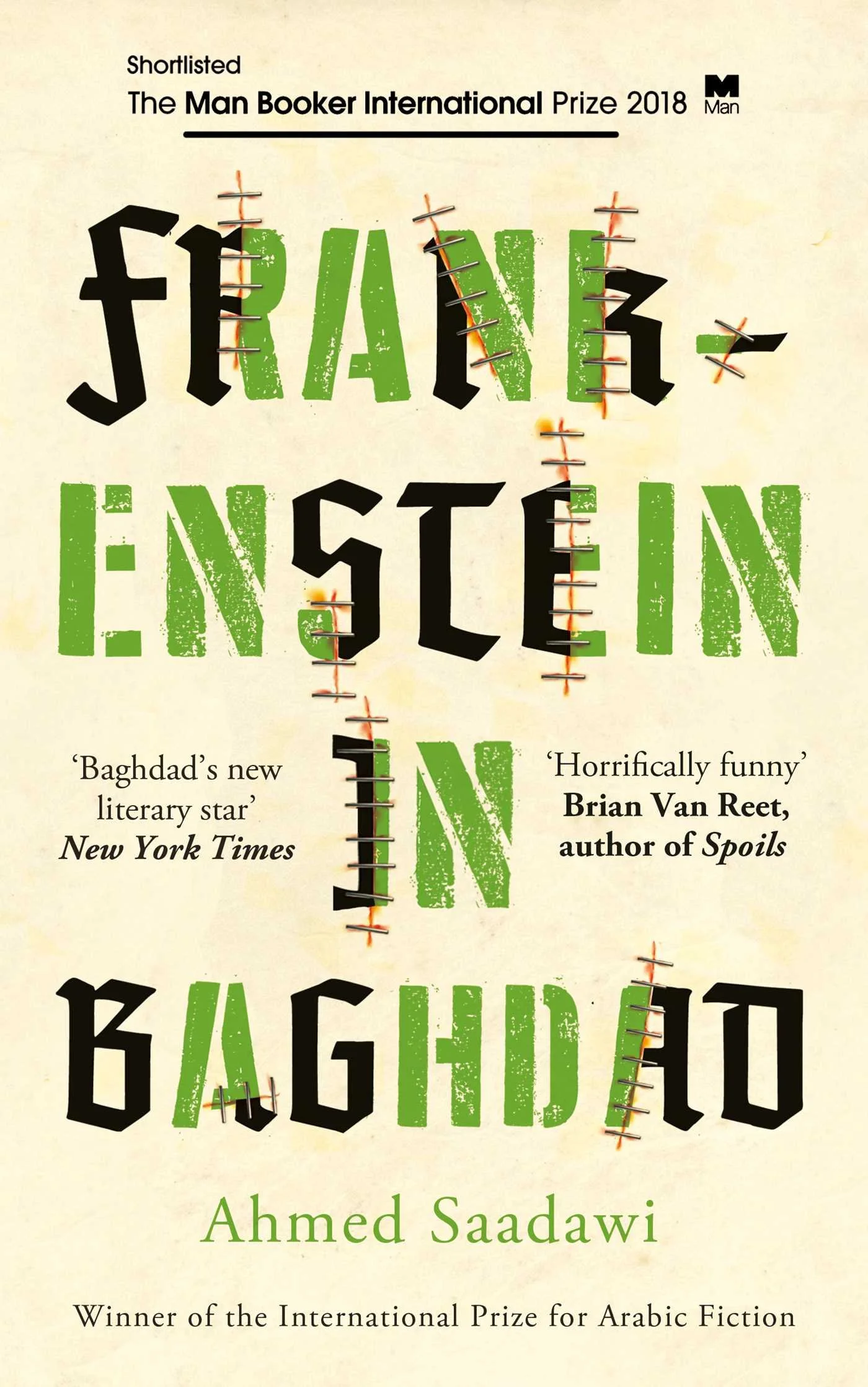
‘Concrete Stories, Decomposing Fictions: Body Parts and Body Politics in Ahmed Saadawi’s Frankenstein in Baghdad.’ Interventions: International Journal of Postcolonial Studies 23.6 (October 2021), pp.922-940
This essay reads the English translation of Ahmed Saadawi’s novel Frankenstein in Baghdad (2018) to explore the “concrete stories” and “infrastructural narratives” devised by the US military in support of its occupation of Baghdad. By stitching together a city and society littered with composing and decomposing fictions, Saadawi’s novel reveals how biopolitical governance produces, contra the hegemonic US war story of security consolidation and societal stabilization, pervasive insecurity instead. Saadawi’s “decomposing fictions”, as I call them, operate on three homologous terrains: the (de)composition of the city; the (de)composition of the body; and the (de)composition of the narrative itself. Through this three-tired conflation, Saadawi shows how body parts are biopolitical, and how narratives actively and materially reshape human bodies and urban infrastructures. By theorizing a more complex relationship between narrative form and the built environment in the contexts of militarized colonial and biopolitical urban governance, the essay shows how Saadawi’s novel not only challenges the “imaginative geographies” of the colonial present, but its material infrastructures as well.
-
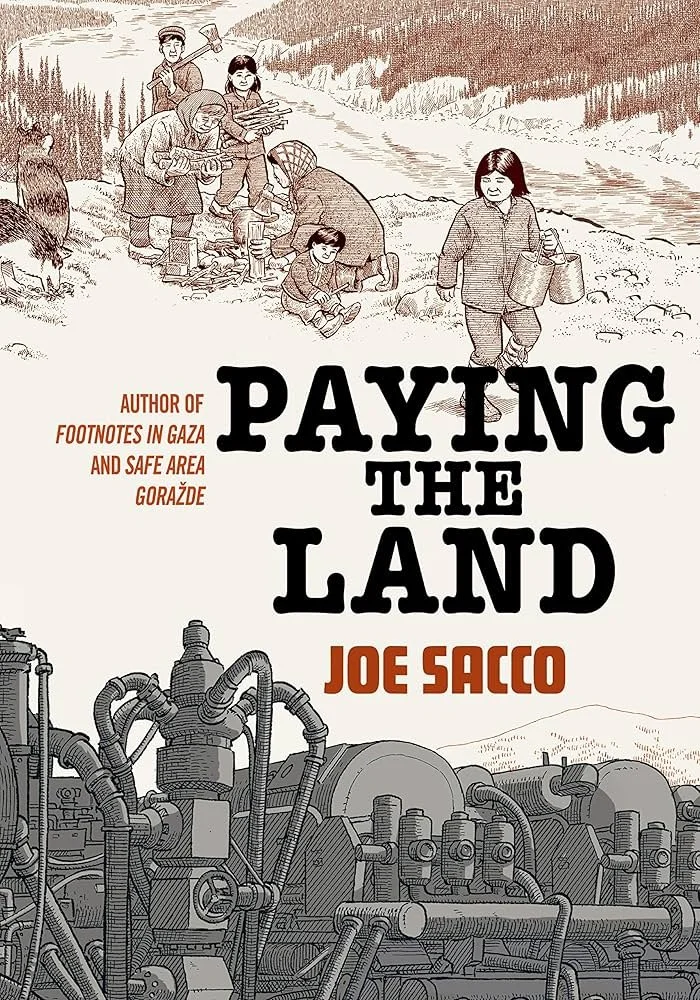
‘Terrestrial Realism and the Gravity of World Literature: Joe Sacco’s Seismic Lines.’ Cambridge Journal of Postcolonial Literary Inquiry 8.3 (September 2021), pp.301-322
Through a close reading of Joe Sacco’s Paying the Land (2020), a graphic novel about the struggle of the Dene people in Canada’s Northwestern territories, this article shows how Sacco effects a “peripheral realism” that draws the systemic continuities of different phases of colonial modernity into view. The article then describes Sacco’s “terrestrial realism,” which combines his peripheral realism with the dialectical participation of the reader as well. In a concluding theoretical discussion, I consider how the practice of drawing allows us to think through a response to modernity’s combined and uneven development that is both materialist and decolonial at the same time.
-
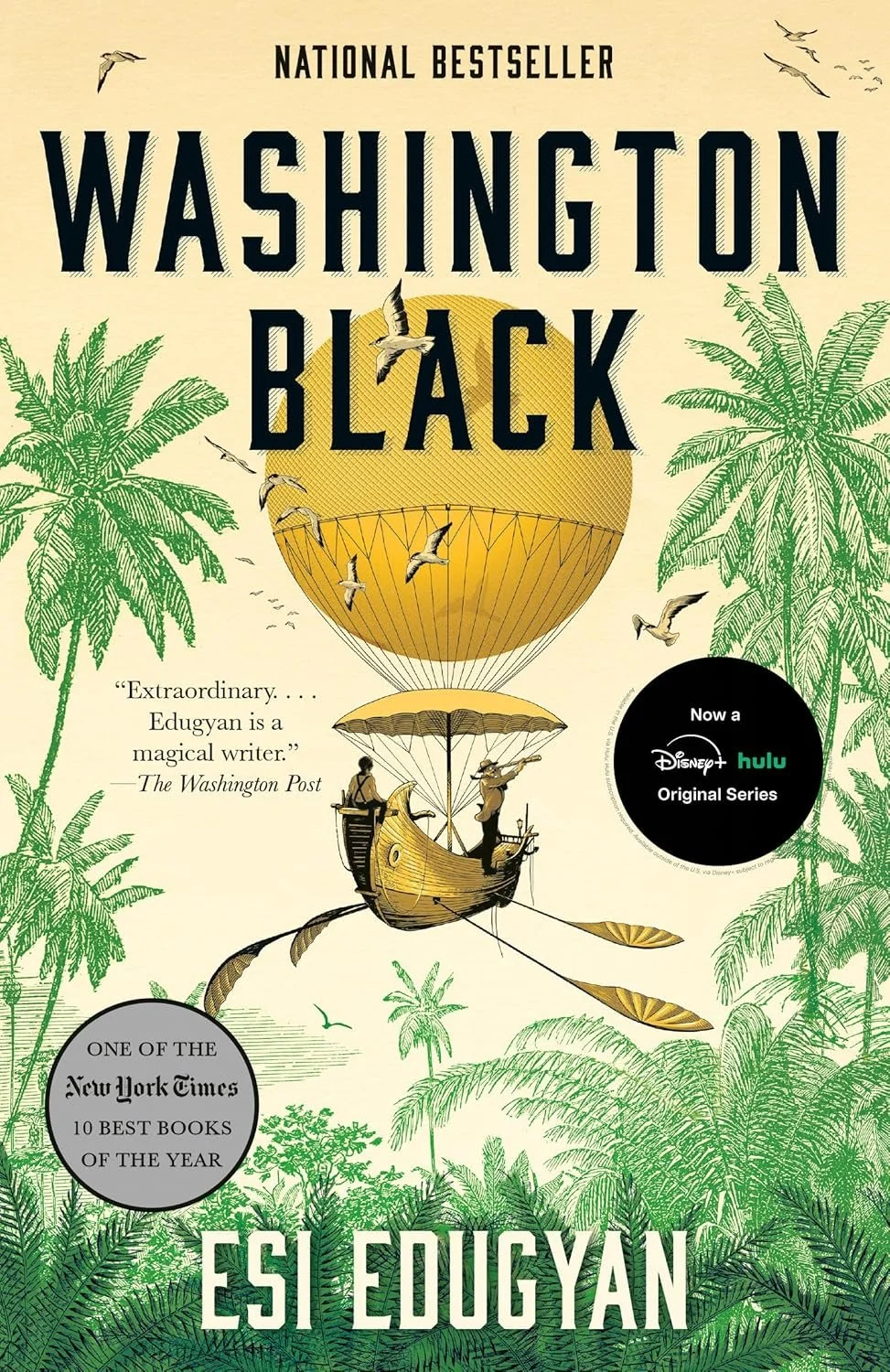
‘Terrestrial Humanism and the Weight of World Literature: Reading Esi Edugyan’s Washington Black.’ Cambridge Journal of Postcolonial Literary Inquiry 8.1 (January 2021), pp.1-23
Through an extended reading of Canadian author Esi Edugyan’s novel, Washington Black (2018), this article aims to revise and reinsert both the practice of close reading and a radically revised humanism back into recent world literature debates. I begin by demonstrating the importance of metaphors of weight to several theories of world literature, before tracking how, with the same metaphors, Edugyan challenges Enlightenment models of earth, worlds, and humanism. The article argues that “terrestrial humanism” might provide a framework from which to develop a grounded, politicized, earthly practice of close reading world literary texts, one that remains open to the contrapuntal geographies, affective materialisms, and radically humanist politics of literary texts themselves.
-
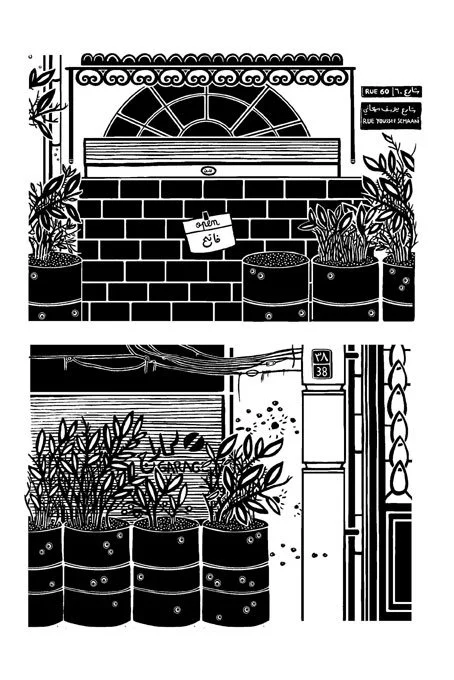
‘Infrastructural Violence: Urbicide, Public Space, and Postwar Reconstruction in Recent Lebanese Graphic Memoirs.’ In Ian Hague, Ian Horton, & Nina Mickwits eds., Contexts of Violence in Comics. New York: Routledge, 2020, pp.128-144
This chapter argues that the cartographic and architectural representations of the city in recent Lebanese graphic memoirs expose the infrastructural violence that both exacerbated and actively participated in Lebanon’s wartime violence. Published some two decades after the overt violence of the Civil War came to an unstable conclusion, these Lebanese graphic memoirs engage ‘post-memorially’ with the infrastructure space of Beirut’s wartime urban landscape. By foregrounding the deeper spatial and structural violence of the war, they seek first to emphasise how this violence endures in the present, and second, to offer a future-oriented vision of a more inclusive, desegregated post-war city space.
-
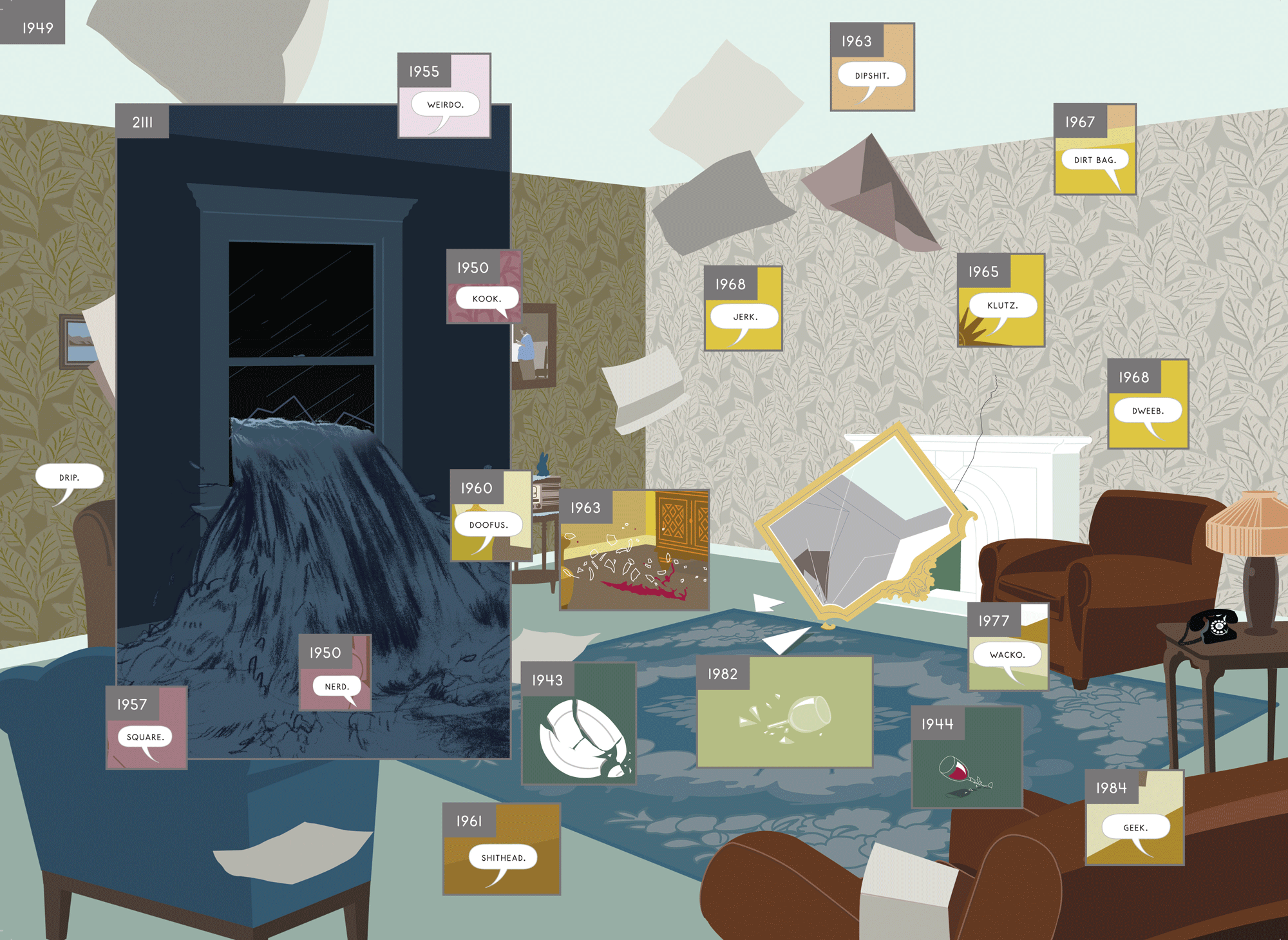
With Filippo Menga. ‘Apocalypse Yesterday: Posthumanism and Comics in the Anthropocene.’ Environment and Planning E: Nature & Space 3.3 (August 2020), pp.663-687
It is widely recognised that the growing awareness that we are living in the Anthropocene – an unstable geological epoch in which humans and their actions are catalysing catastrophic environmental change – is troubling humanity’s understanding and perception of temporality and the ways in which we come to terms with socio-ecological change. This article explores how the impending environmental catastrophe can be productively reimagined through graphic narratives, arguing that popular culture in general, and comics in particular, emerge as productive sites for geographers to interrogate and develop posthuman methodologies and narratives. Developing our analysis around two comics in particular – Here and Mad Max: Fury Road – we show how graphic narrative can help us to move beyond the nature–society divide that is rendered anachronistic by the Anthropocene.
-
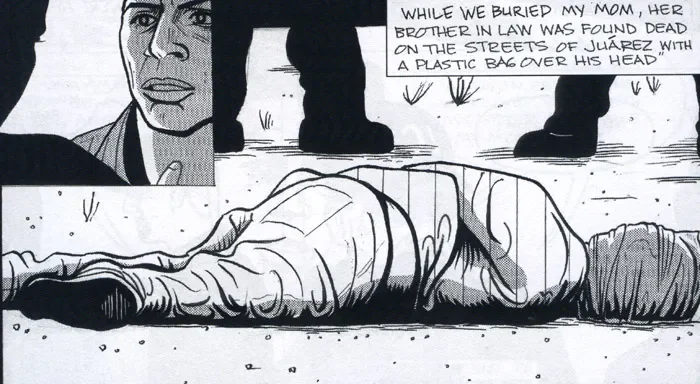
‘Dreamlands, Border Zones, and Spaces of Exception: Comics and Graphic Narratives on the US-Mexico Border.’ a/b: Auto/Biography Studies 35.2 (March 2020), Special Issue: Migration, Exile, and Diaspora in Graphic Life Naratives, pp.383-403
This article explores the connections between the spaces of exception along national borders and the bordered architecture of graphic narratives in Charles Bowden and Alice Leora Briggs’ Dreamland: The Way Out of Juarez (2010) and Jon Sack’s La Lucha: The Story of Lucha Castro and Human Rights in Mexico (2015). Drawn to the US-Mexico border, both of these graphic narratives make visible the routine violence of a nation-state system that devalues human life through the production of spaces of exception. Yet they also begin to make visible—and participate in—the array of spatial practices that challenge the violence these borders inflict, countering a refusal to “see” these spaces and self-reflexively detailing the processes by which the identities of border victims are recovered and documented.
-

‘Graphic Katrina: Disaster Capitalism, Tourism Gentrification, and the Affect Economy in Josh Neufeld’s AD: New Orleans After the Deluge.’ Journal of Graphic Novels & Comics 11.3 (2020), pp.325-340
This article explores the ways in which Josh Neufeld’s documentary comic, A.D.: New Orleans After the Deluge, offers a radical visual commentary on the processes of disaster capitalism and tourism gentrification that have reshaped New Orleans since Hurricane Katrina. A.D.’s biblical imagery evokes the proto-corporate language of the ‘blank canvas’ in order to critique regimes of disaster capitalism, while its vertical multi-scalar perspectives meanwhile resist the racism of media coverage of the event. Through colouring and other aesthetic choices, the comic also challenges the subsequent propagation of an ‘authentic image’ of New Orleans that promotes tourism gentrification.
-
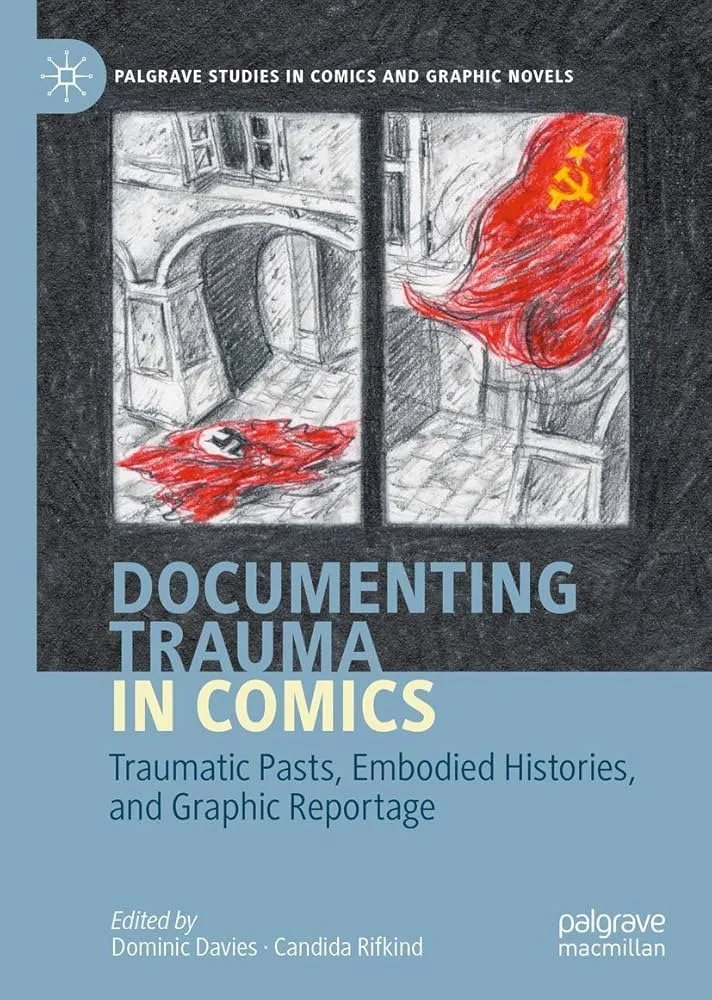
‘Introduction: Documenting Trauma in Comics.’ In Dominic Davies & Candida Rifkind eds., Documenting Trauma in Comics: Traumatic Pasts, Embodied Histories, & Graphic Reportage. New York: Palgrave Macmillan, 2020, pp.1-26
This introduction unpacks some of the many complex connections between trauma, comics, and documentary form. It begins by theorising trauma as a ‘sticky’ concept that troubles disciplinary boundaries, before suggesting that comics such as Art Spiegelman’s Maus (1980–1991) have played a significant role in the active production—rather than simply reflection or reification—of cultural and academic conceptions of trauma. It then turns to a critical overview of Caruthian and other hegemonic models of trauma, combining this with brief outlines of each of the book’s chapters to show how they seek to unsettle a dominant ‘trauma paradigm’, or to divert away from a recognised ‘trauma aesthetic’. The introduction concludes by drawing out and reiterating the book’s overarching contention: that comics are a generative force at the core of trauma itself, moulding and melding it into new shapes that might provide new models for working it through in the future.
-
‘Crossing Borders, Bridging Boundaries: Reconstructing the Rights of the Refugee in Comics.’ In Elena Fidian-Qasmiyeh ed., Refuge in a Moving World. London: UCL Press, 2020, pp.177-192
It is into a visual culture, both of imagistic ephemerality and of prevalent anti-migrant sentiment, that comics effectively intervene. In the age of the internet, viewers in the West are trained on a daily basis to make sense of multiple images spliced with pieces of text, as they log onto Facebook feeds or scan through Twitter. Comics, especially those published online (as is the case for these refugee comics), tap into this constant stream of information, harnessing the experience of information transmission and consumption to which viewers are becoming increasingly accustomed. The laboured etchings of comics journalism offer an antidote not only to the lack of visualization but also the decontextualization of photographic images that, in their proliferation, are reduced to insignificance.
-
‘Urban Comix: Subcultures, Infrastructures and “the Right to the City” in Delhi.’ In Alex Tickell & Ruvani Ransinha ed., Delhi: New Literatures of the Megacity. London & New York: Routledge, 2020, Chapter 9
This article argues that comics production in India should be configured as a collaborative artistic endeavour that visualizes Delhi’s segregationist infrastructure, claiming a right to the city through the representation and facilitation of more socially inclusive urban spaces. Through a discussion of the work of three of the Pao Collective’s founding members – Orijit Sen, Sarnath Banerjee and Vishwajyoti Ghosh – it argues that the group, as for other comics collectives in cities across the world, should be understood as a networked urban social movement. Their graphic narratives and comics art counter the proliferating segregation and uneven development of neo-liberal Delhi by depicting and diagnosing urban violence. Meanwhile, their collaborative production processes and socialized consumption practices create socially networked and politically active spaces that resist the divisions marking Delhi’s contemporary urban fabric.
-
‘Feelings in Common: Democracy as Maintenance and Repair.’ Violence & Democracy, A Joint British Academy (UK) and Centre for the Study of Developing Societies (India) Publication (September 2019), pp.23-27
In this short reflective paper, I want to consider briefly how these common ‘feelings’ come about, and how they relate to feelings, or ‘atmospheres’, of democracy. I will try briefly to explore the political, physical and affective infrastructures that might bring these feelings into being – or that conversely might curtail and inhibit them. And I will conclude by suggesting that it is not only through building and developing new such infrastructures that democratic atmospheres might be conjured; just as importantly, it is through the routine activities of maintenance and repair that feelings of social and political commonality might be revitalised. In order to contain these admittedly large and riskily abstract reflections, I will route them through the specific context of contemporary Britain, focusing in particular on the conditions created by the political phenomenon of austerity.
-
‘Literary Non-Fiction and the Neoliberal City: Subalternity and Urban Governance in Katherine Boo’s Behind the Beautiful Forevers.’ Journal of Postcolonial Writing 55.1 (February 2019), pp.94-107
This article challenges claims made for Katherine Boo’s Behind the Beautiful Forevers as a piece of non-fiction, using the text to explore questions around subaltern agency and voice that have been at the centre of postcolonial studies since Gayatri Chakravorty Spivak asked: “Can the Subaltern Speak?” It foregrounds the continued relevance of Spivak’s question in the postmillennial context of the neoliberal city, particularly as it relates to issues of urban governance, and argues that a postcolonial reading of Boo’s book reveals a new set of triangulated connections between subalternity, literary non-fiction and the neoliberal Indian cities. Beautiful Forevers reveals how the violent infrastructures of such cities continue to be shaped by the legacies of colonialism and exacerbated by neo-liberal urban governance, and how the genre of literary non-fiction is responding to this neoliberal urban regime.
-
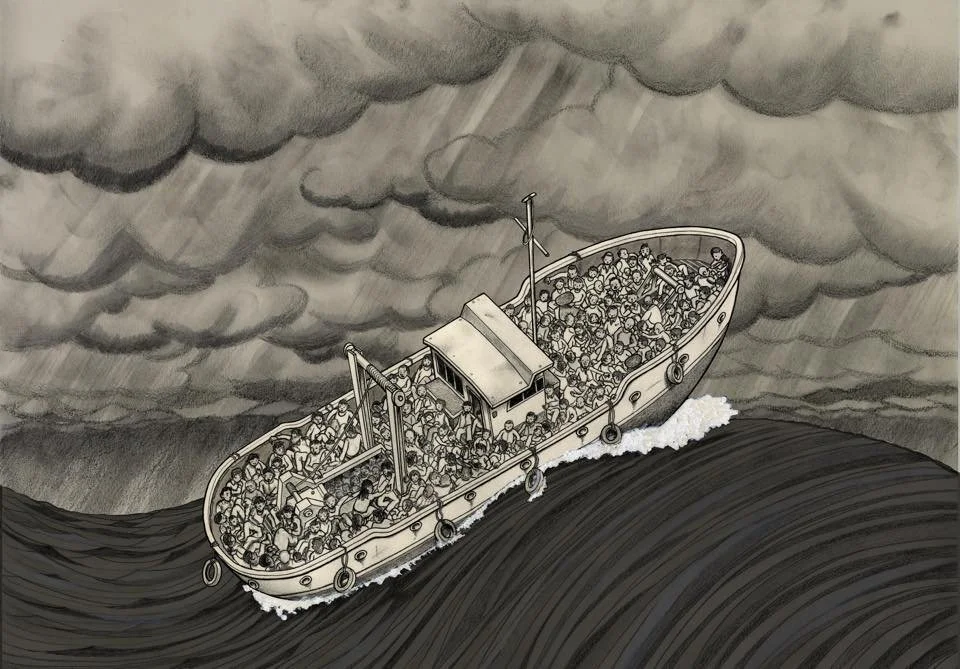
‘Braided Geographies: Bordered Forms and Cross-Border Formations in Refugee Comics.’ Journal for Cultural Research 23.2 (October 2019), pp.123-43
This article offers a close analysis of a trilogy of ‘refugee comics’ entitled ‘A Perilous Journe.’ It argues that it is by building braided, multi-directional relationships between different geographic spaces, both past and present, that refugee comics realise a set of counter- geographic and potentially decolonising imaginaries. Through their spatial form, refugee comics disassemble geographic space to reveal counter-geographies of multiple synchronic and diachronic relations and coformations, as these occur between different regions and locations, and as they accumulate through complex aggregations of traumatic and other affective memories. The article shows how the counter-geographies visualised by refugee comics can subvert the geopolitical landscape of discrete nation-states and their territorially bound imagined communities.
-
‘Rudyard Kipling and the Networks of Empire: Writing Imperial Infrastructure in The Light that Failed and Captains Courageous.’ In Promodini Varma & Anubhav Pradhan eds., Proximate Strangers: Kipling and Yeats at 150. London & New York: Routledge, 2019, pp.192-210
In the 1890s, Kipling wrote two novels: The Light that Failed (1891) and Captains Courageous (1896). These first attempts at novel writing have widely been regarded by literary critics as failures, and their publication and sales history suggests as much. I argue that Kipling, at a historical moment in which communication and transport networks were drastically expanding across the face of the globe, was struggling to write a novel that represented these imperial infrastructures and global networks in the worldly reach they were beginning to attain. The fact that these efforts failed in this regard is revealing – by counter-intuitively looking at the moments when his novels fail, this chapter asks what they might be able to tell us about imperial identity, global consciousness, and the rise of an imperial network of physical infrastructures and highways of communication and exchange that still, at least in some part, shape the world in the twenty-first century.
-
With Elleke Boehmer. ‘Postcolonialism and South-South Relations.’ In Elena Fiddian-Qasmiyeh ed., The Routledge Handbook of South-South Relations. London & New York: Routledge, 2018, pp.48-58
Postcolonial studies or postcolonialism is a critical theoretical approach that emerged in the Anglo-American academy in the 1980s, and has tended to base itself at once conceptually and politically on a division of the world into ‘the West’ and ‘the rest’, even as it then sets out to challenge such distinctions. This rest was first understood to be the non-aligned ‘Third World’ or developing world, but has more recently come to be referred to as the global South. The subject of its critique was the formal dissolution of the imperial world from the 1940s to the 1960s and its methodology was cross-disciplinary, applied to various subjects from the literary and cultural to the anthropological and economic. Postcolonial criticism was specifically concerned to question, deconstruct and undermine binary divisions of colonial self and colonised other, and to nuance, complicate and interrogate paradigms of West and rest, us and them.
-
‘Urban comix: Subcultures, Infrastructures, and “the Right to the City” in Delhi.’ Journal of Postcolonial Writing 43.3 (June 2018), Special Issue: Delhi: Writings on the Megacity, pp.411-430
This article argues that comics production in India should be configured as a collaborative artistic endeavour that visualizes Delhi’s segregationist infrastructure, claiming a right to the city through the representation and facilitation of more socially inclusive urban spaces. Through a discussion of the work of three of the Pao Collective’s founding members – Orijit Sen, Sarnath Banerjee and Vishwajyoti Ghosh – it argues that the group, as for other comics collectives in cities across the world, should be understood as a networked urban social movement. Their graphic narratives and comics art counter the proliferating segregation and uneven development of neo-liberal Delhi by depicting and diagnosing urban violence. Meanwhile, their collaborative production processes and socialized consumption practices create socially networked and politically active spaces that resist the divisions marking Delhi’s contemporary urban fabric.
-
‘Performing Urban Violence: Protest Theatre and Semi-Public Space in London and Cape Town.’ Theatre Topics 28.2, Special Issue: Protest Theatre (July 2018), pp.89-100
This essay offers an account of two case studies of theatrical performance in London and Cape Town, both of which raise and interrogate the interrelated concepts of protest theatre and public space. A production of Tunde Euba’s play Brothers by the Greenwich and Lewisham Young People’s Theatre (GLYPT) in London and awareness-raising campaigns of the Sex Workers Education and Advocacy Taskforce (SWEAT) in Cape Town both use performance to question, diagnose, and protest multiple forms of violence perpetrated against marginalized urban populations, often at the hands of the state. In twenty-first-century neoliberal cities such as London and Cape Town, government and private forces collude to privatize their once public spaces, thus encroaching upon, if not entirely disappearing, venues that might be used for protesting against such forms of violence. In response, I argue that GLYPT and SWEAT cultivate semi-public spaces and use a kind of interactive theatre to foster community solidarity among marginalized urban inhabitants.
-
With Elleke Boehmer. ‘Planned Violence: Post/Colonial Urban Infrastructure, Literature & Culture.’ In Boehmer & Davies eds., Planned Violence: Post/Colonial Urban Infrastructure, Literature, & Culture. London & New York: Palgrave MacMillan, 2018, pp.1-25
In this introduction, we focus on the ways in which literary and cultural production is able to offer a critical purchase on planned violence, a concept we outline in more detail below. How does culture excavate, expose and challenge such violence? As importantly, we are interested in how these cultural forms contribute to more productive processes of social and infrastructural re-imagination and reconfiguration, and therefore also include three pieces of creative writing at the collection’s turning points. How does the post/colonial city ‘emerge as an idea and a form in contem- porary literatures of the city?’ What are the ‘literary infrastructures’ that help to give the city imaginary shape? What forms can build ‘alternative city-spaces’? And finally, what are the ‘disruptive questions’ that literary texts ask of urban infrastructure, ‘including in actual practice, on the ground’?
-
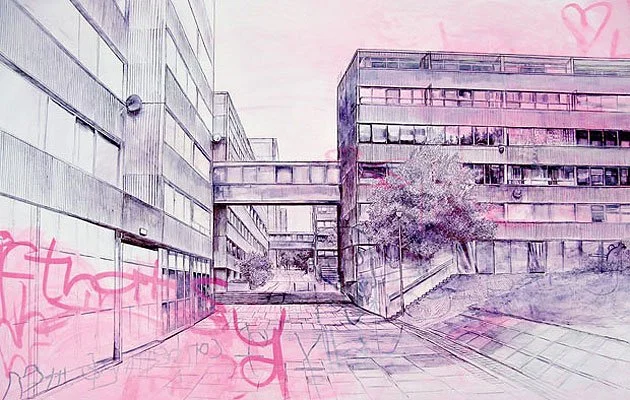
‘“Comics on the Main Street of Culture”: Alan Moore and Eddie Campbell’s From Hell, Laura Oldfield Ford’s Savage Messiah, and the Politics of Gentrification.’ Journal of Urban Cultural Studies 4.3 (October 2017), pp.333-361
Through a comparative discussion of Alan Moore and Eddie Campbell’s From Hell (serialized 1989−96, collected 1999), which is now widely marketed as a ‘graphic novel’, and Laura Oldfield Ford’s more self-consciously subcultural zine, Savage Messiah (serialized 2005 to 2009, collected 2011), this article explores the correlation between the gentrification of the comics form and the urban gentrification of city space − especially that of East London, which is depicted in both of these sequential art forms. The article emphasizes that both these urban and cultural landscapes are being dramatically reshaped by the commodification and subsequent marketization of their subcultural or marginalized spaces, before exploring the extent to which they mobilize their subversive, anti-gentrification political content more effectively, constituting radical urban subcultures that resist the reshaping of London into a segregated and discriminatory cityscape.
-
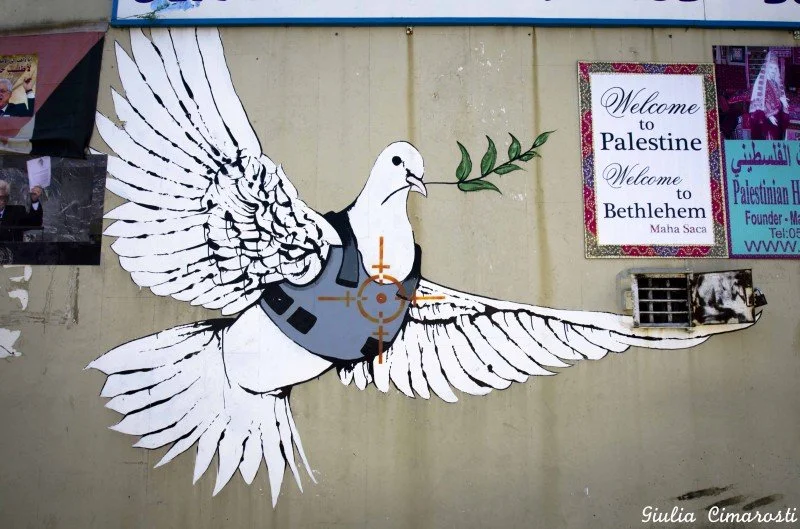
‘“Walls of Freedom”: Street Art and Structural Violence in the Global City.’ Rupkatha Journal on Interdisciplinary Studies in Humanities IX.1 (June 2017), pp.6-18
This article argues that contemporary street art (or graffiti) uses a unique set of resistant techniques to foreground the contours and shapes of different kinds of structural violence inscribed into, and perpetuated by, the infrastructural layouts of the twenty-first century’s increasingly global cities. Graffiti can resist structural violence as it is shaped and exacerbated by—even embedded within—the physical walls of city spaces, ricocheting off into alternative and on occasion more democratic modes of urban habitation. Through a discussion of examples from urban spaces as diverse as revolutionary Cairo, divided East Jerusalem and the West Bank in Palestine, and South African townships and gentrifying East London, the article shows that street art can transform the violent infrastructures of oppressive state governance into a canvas that articulates calls for democratic and political freedom.
-
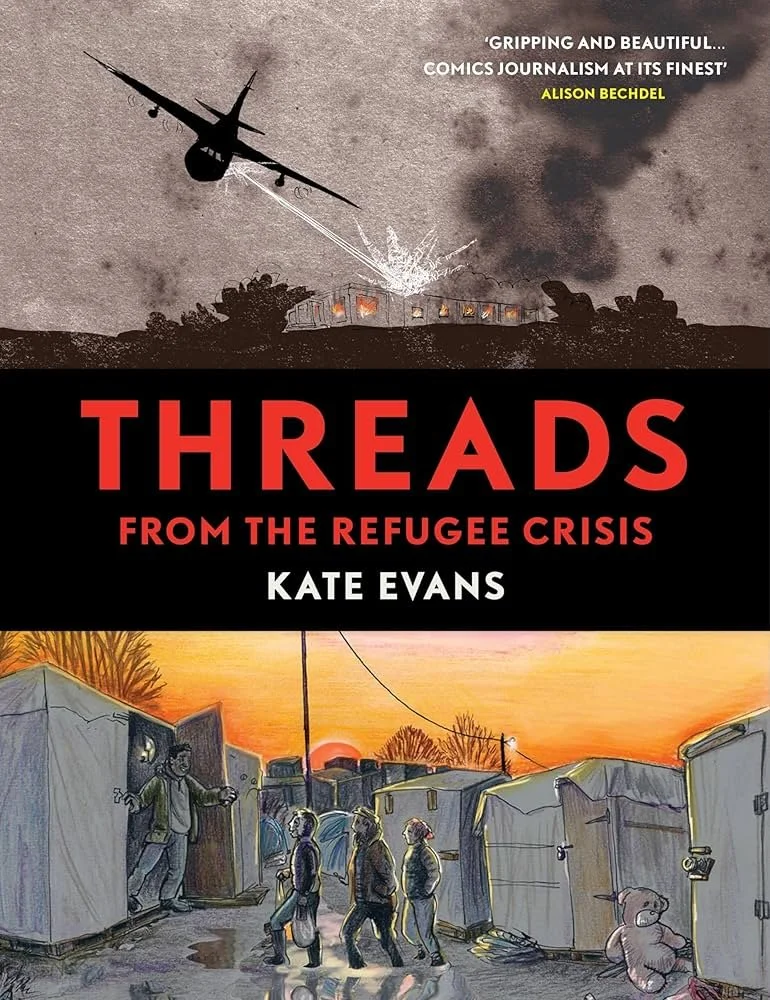
‘Comics Activism: An Interview with Comics Artist Kate Evans.’ The Comics Grid: Journal of Comics Scholarship 7.1 (November 2017), p.18
This is an interview with comics artist Kate Evans, author of Red Rosa (2015) and Threads: From the Refugee Experience (2017), as well as a number of other comics, about her recent work, which operates at the intersection of several of the most exciting genre developments in comics in recent years. In the interview Evans reflects on recent shifts in comics journalism, as well as other trends in the field such as the rise of graphic memoir, through examples taken from Evans’s own work as well as that of Joe Sacco, Lynda Barry, Alison Bechdel and others.
-
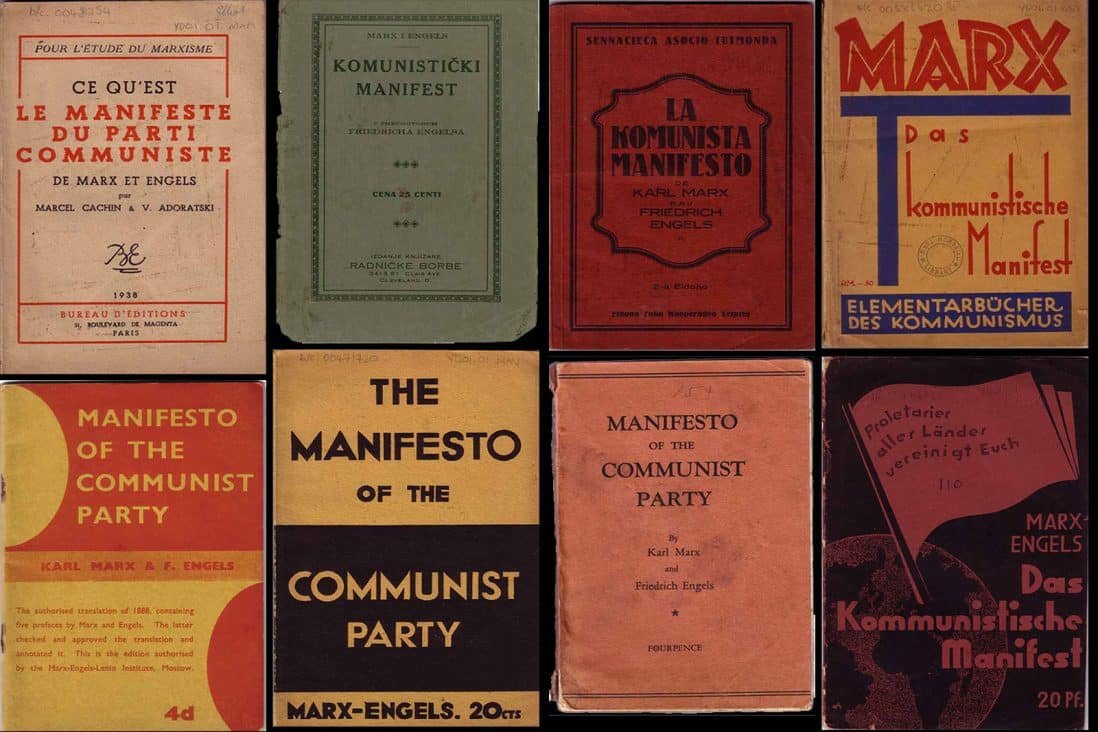
‘From Communism to Postcapitalism: Marx and Engels’ The Communist Manifesto.’ In Dominic Davies, Erica Lombard & Benjamin Mountford eds., Fighting Words: Fifteen Books that Shaped the Postcolonial World. Oxford: Peter Lang, 2017, pp.27-42
History bears testament to the Manifesto’s planetary circulation, global readership and material impact. The text is somehow able to outline the complex theoretical foundations for the world’s most enduring critique of capitalism in a comprehensible and persuasive language. Whilst arguing for the importance of the Manifesto as an anti-imperial book and exploring the reasons for its viral circulation, this chapter will also show that it is a self-reflexive text that predicts its own historic impact. It is the formal and generic – or, in fact, ‘literary’ – qualities of this astonishing document that have given it such primacy in the canon of anti-imperial and anti-capitalist writing.
-
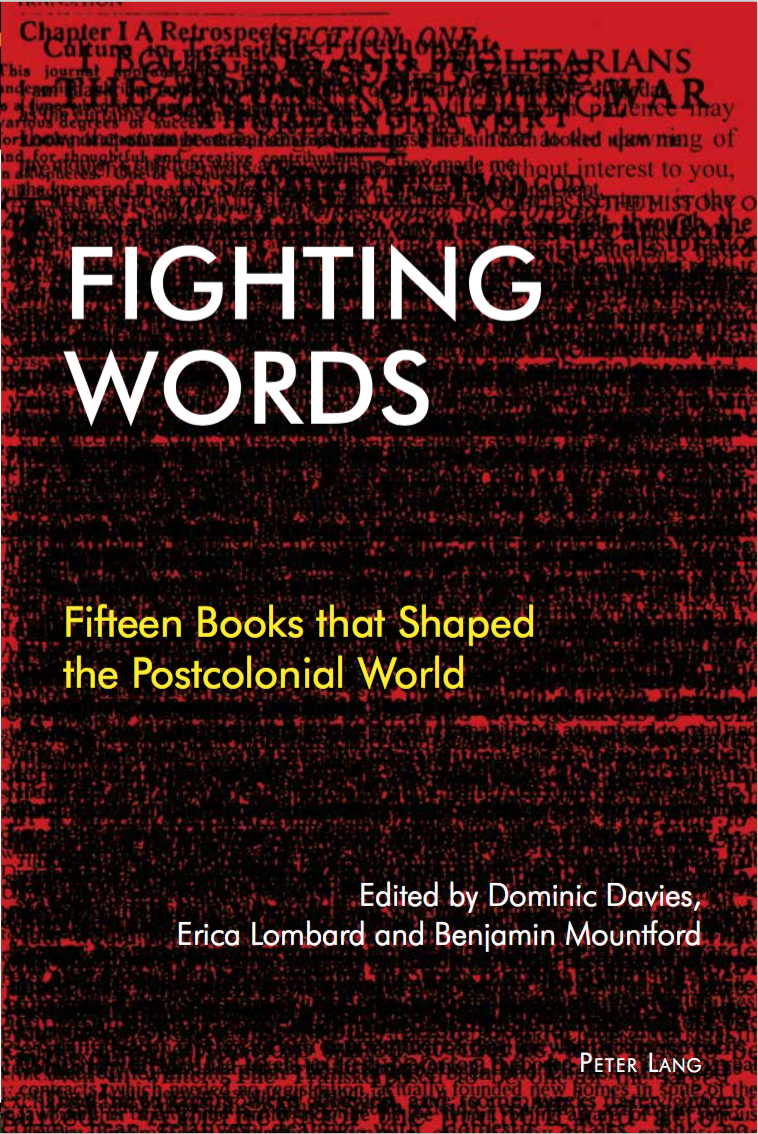
With Erica Lombard & Benjamin Mountford. ‘Introduction. Fighting Words: Books and the Making of the Postcolonial World.’ In Davies, Lombard & Mountford eds., Fighting Words: Fifteen Books that Shaped the Postcolonial World. Oxford: Peter Lang, 2017, pp.1-26
Can a book change the world? If books were integral to the creation of the imperial global order, what role have they played in resisting that order throughout the twentieth century? To what extent can anti-imperial and anticolonial resistance movements across the planet be traced back to, or be found to have their ideas rooted in, materially circulating texts? These questions undergird the fifteen chapters of which this collection is comprised, which together examine how the book as both a cultural form and material object has fuelled resistance to empire and shaped the contours of the postcolonial world in the long twentieth century.
-
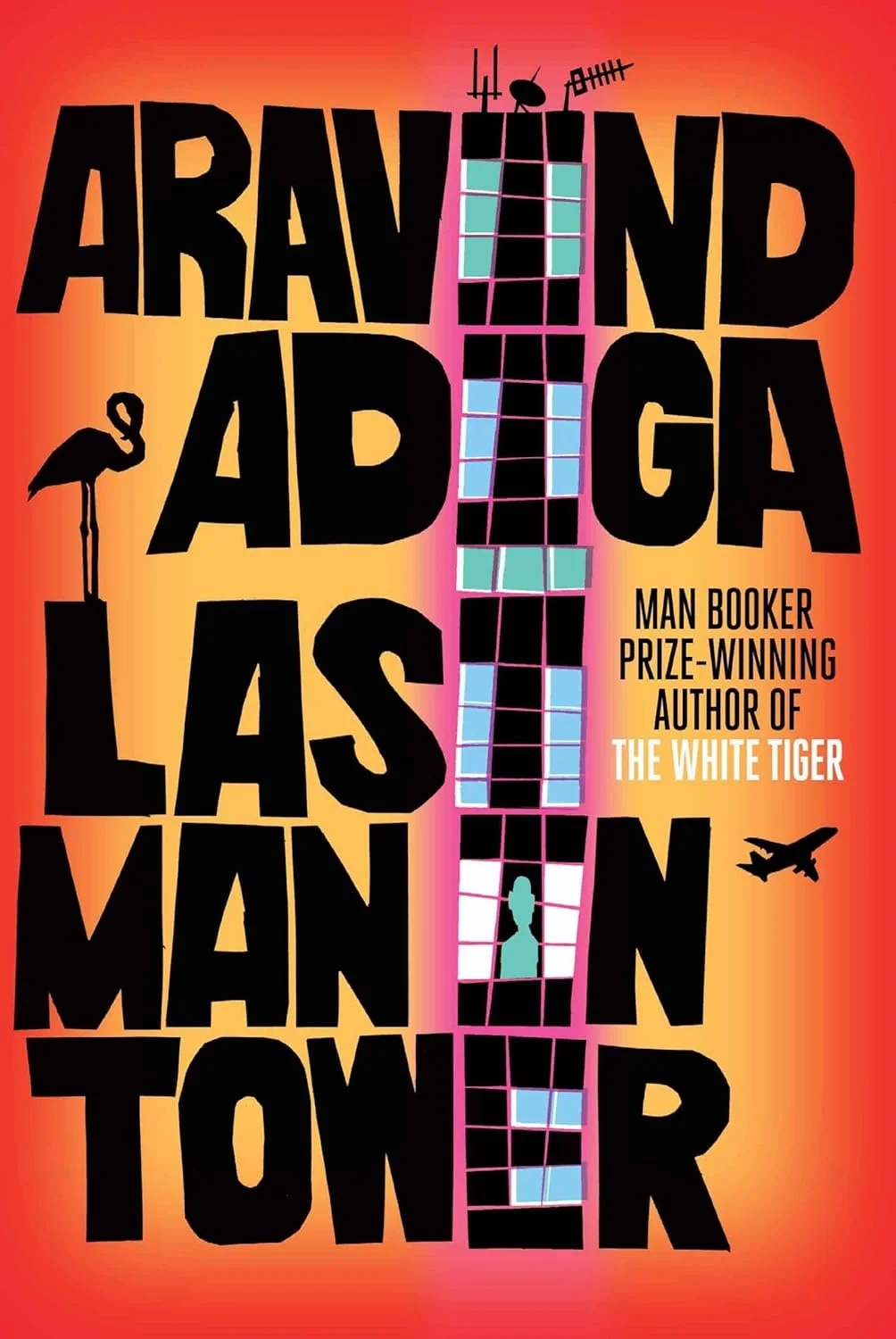
‘Occupying Literary and Urban Space: Adiga, Authenticity, and the Politics of Socioeconomic Critique.’ In Alex Tickell ed., South-Asian Fiction in English: Contemporary Transformations. New York: Palgrave Macmillan, 2016, pp.119-138
This chapter argues that Aravind Adiga’s Last Man in Tower moves beyond idiosyncratic concerns around issues of authenticity to produce a discursive space of dissent in opposition to the economic inequalities and pervasive corruption of the socio-political context in which it is set. The narrative throws the wider political and socio-economic effects of neoliberalism into relief as they manifest primarily in the policies of urban land redevelopment that are symptomatic of Mumbai’s contentious history around property and land rights. The novel also uses the Bombay Rent Act of 1979 as a lens with which to shed light on the corruption and profit-oriented complicity of various national and state institutions that have, in twenty-fi rst-century Mumbai, become the servants of capital.
-
‘Comics Journalism: An Interview with Josh Neufeld.’ International Journal of Comic Art 18.2 (October 2016), pp.299-317
In this interview, Josh Neufeld talks about the phenomenon of comics journalism, his personal development as an artist and journalist, as well as his book, A.D., and the story behind its creation. He also discusses one of his most recent projects, a comic published in Foreign Policy magazine, entitled ‘The Road to Germany: $2400’, which integrates original reporting by Alia Malek and photographs by Peter van Agtmael to tell the story of Syrian refugees as they attempt to cross into Europe. He reflects on the difficulties and productivities of working collaboratively with other writers and journalists, and some of his current projects and ideas for the future.
-
‘Geography, Topography, Infrastructure: Mapping the Oscillations of the Frontier in John Buchan’s Prester John (1910)’. Tropos 2.1 (September 2015), pp.14-21
This paper develops a conceptual map of ‘frontier consciousness’, outlining this ideological perspective that gave shape to a strand of Britain’s imperial relationship with South Africa at the turn of the twentieth century. It does so through an application of world-systems theory to the textual ‘mappings’ of John Buchan’s frontier novel, Prester John (1910). Frontier consciousness comes into being through its proximity to the unknown spaces of the discursive African interior and its distance from the imperial metropole. But in the very process of describing these unknown spaces they necessarily become known: frontier consciousness, as articulated and mapped by Buchan’s novel, has thus to continuously produce and re-produce new unknown geographical areas in order to maintain the binary simplicity that allows it to come into being (‘civilisation’ vs. ‘savagery’ and so on). It is caught in a constant production of spatial distance and the simultaneous need to become proximal to it.
-
With Elleke Boehmer. ‘Investigating the Southern City through Postcolonial Literature: Infrastructures in Delhi, Johannesburg, and London.’ Journal of Postcolonial Writing 51.4 (May 2015), pp.359-409
This article explores the ways in which postcolonial literary and other cultural texts navigate, decode and in some cases re-imagine the infrastructures that organize urban life, particularly in the postcolonial cities of Johannesburg, London and Delhi. Readings of Ivan Vladislavić, Mark Gevisser, Brian Chikwava, Selma Dabbagh, Rana Dasgupta, and Manju Kapur consider the constantly shifting relationship between urban planning, the organization of public space, and various other forms of human intervention, and suggest that the ways in which urban spaces are mapped in creative practice can explore, negotiate and at times disrupt and reconstruct that relationship.
-
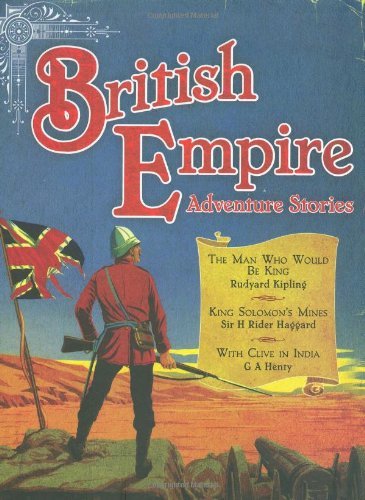
‘The Kipling Scrapbooks and the End of Empire.’ The Kipling Journal 88.353 (March 2014), pp.21-31
The Kipling Scrapbooks show how Kipling made available a lexicon that newspapers, and both popular and high culture more broadly, would use to speak about the British Empire. Of course the way in which this vocabulary is used is always evolving and shifting, being transformed through forms of satire, critique, resistance, and so on. But the fact that these divergences nevertheless take something of Kipling’s vast oeuvre as their starting point, even when misquoted, or even misattributed, demonstrates the influence of Kipling on twentieth-century thought about the British Empire, and empire in general.
-
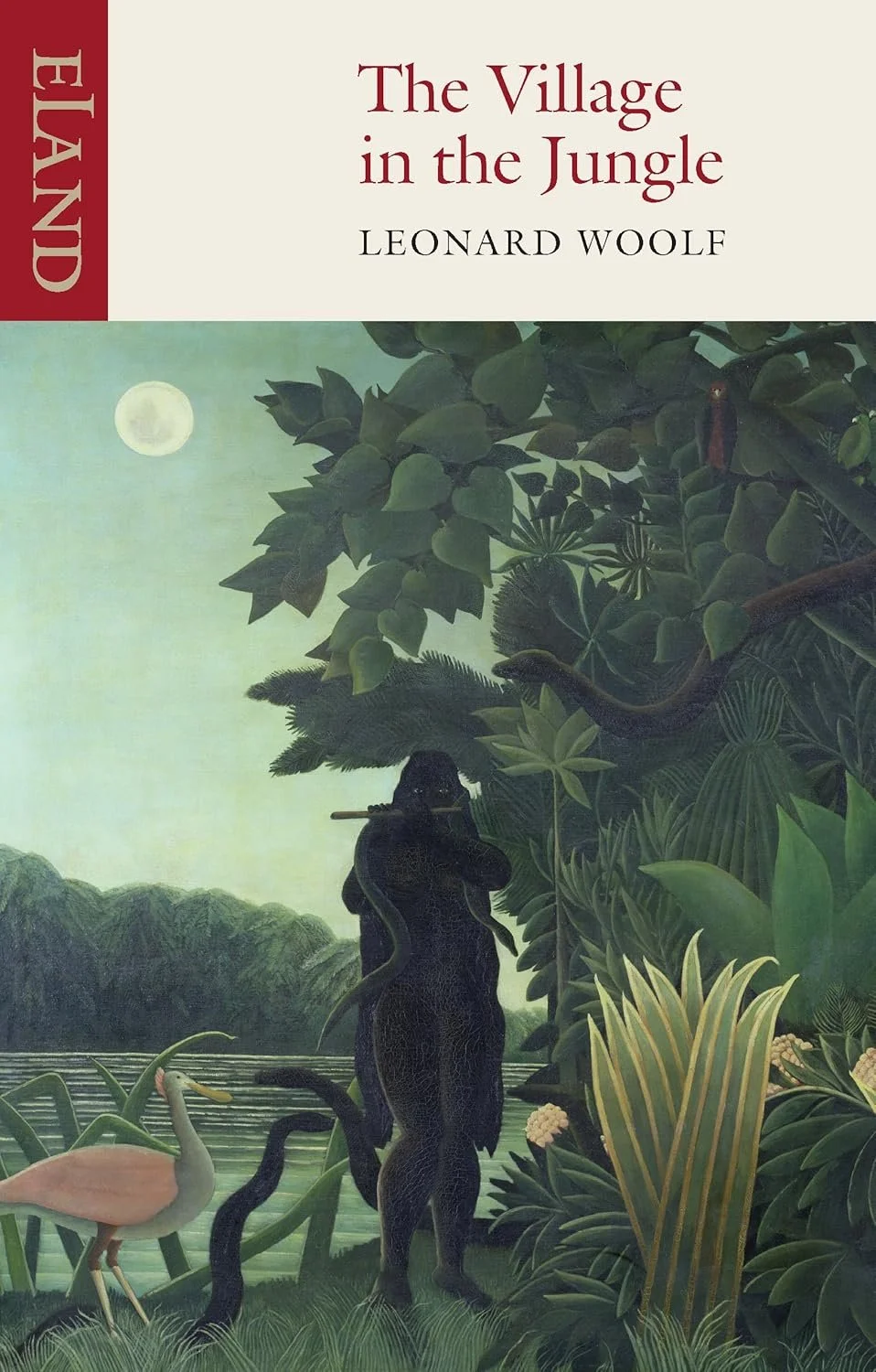
‘Critiquing Global Capital and Colonial (In)Justice: Structural Violence in Leonard Woolf’s The Village in the Jungle (1913) and Economic Imperialism (1920).’ Journal of Commonwealth Literature 50.1 (November 2014), pp.45-58
By drawing on theories of structural violence and applying them to Leonard Woolf’s first novel, The Village in the Jungle (1913), this article argues that the fictional work allowed Woolf to think through certain political, legal, social, and cultural issues that would later inform and enhance his extensive engagement with, and critique of, global capital and colonial and international judicial systems. Written from a victim-oriented perspective, the novel excavates the varying layers of structural violence as they are spread both socially and also geographically to show how the colonial administration and its legal system are complicit with, if not actively facilitating, the exploitation of Ceylon by the structures of global capitalism, as well as highlighting the ramifications of the unevenly developing capitalist economy that slowly sutures the island into these cross-national networks. The article concludes by arguing that the novel lays important foundations for Woolf’s later thought on exploitative imperialisms and the international judicial system, The League of Nations, of which he was an architect.
-
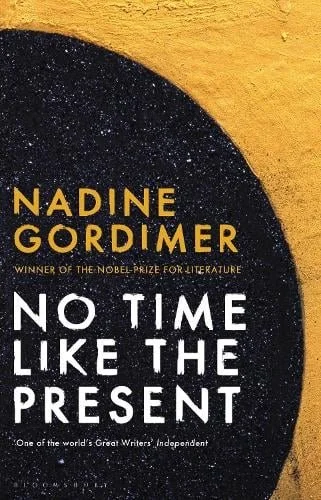
‘“Simple as the black letters on this white page”: Nadine Gordimer’s Grey Politics in No Time Like the Present (2012).’ Études Littéraires Africaines (ELA) 38, Special Issue: South Africa and Post-Apartheid Literature (1994-2014) (July 2014), pp.83-92
Nadine Gordimer's last novel, No Time Like the Present (2012), revolves around the central theme of the conflict between the pursuit of political commitment, and the weariness or disillusionment that politics induces. By comparing Gordimer's final novel to her first, The Lying Days (1953), and drawing on Fredric Jameson's work on national allegory, this article demonstrates how No Time Like the Present describes and critiques the changing relationships between literature and politics in a South African context. The novel pushes to the extreme the limits of the allegorical constraints imposed by the political context in order to reveal that nothing is as "simple as black letters on a white page." The result is a formal ambivalence that expresses the absence of a clear post-apartheid political direction— a difficult situation that I describe as the novel's "gray zone."
-
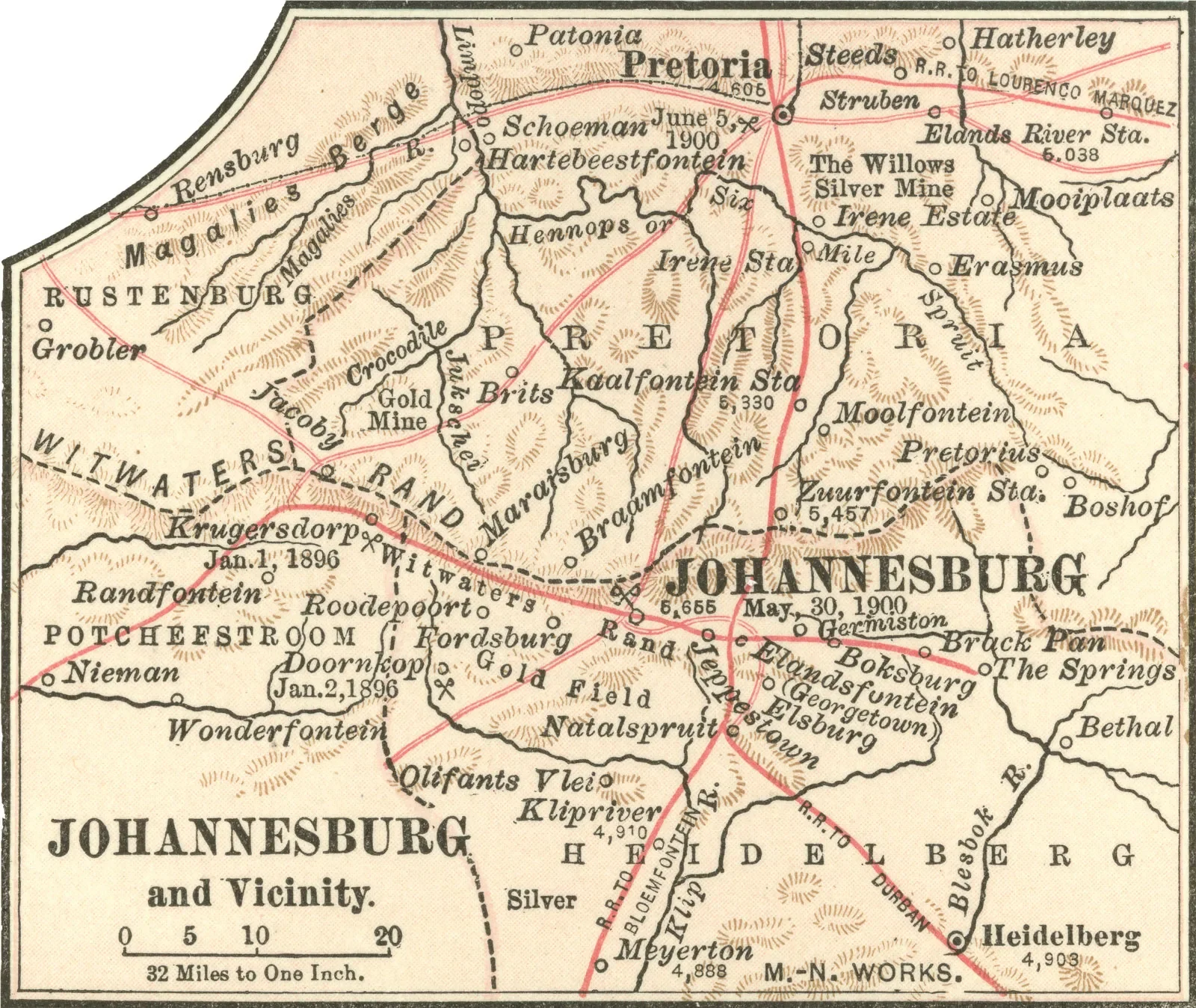
‘Spaces of Domination and Resistance: King Solomon’s Mines (1885), Ula Masondo (1927), and Literary Geographies of South Africa.’ HARTS & Minds: The Journal of Humanities and Arts 1.2 (October 2013), pp.1-17
The imperial romance depicted the South African landscape as both empty and thus easily penetrable for the imperialist, and as embedded with mineral wealth available and accessible for profitable resource extraction. The romance was involved in the production of an idealised geography of South Africa for the metropolitan imagination, writing the presence of emerging urban spaces such as Johannesburg out of its cartographic representations. By inverting a number of the key genre-defining tropes, William Plomer’s Ula Masondo (1927) shifts the focus of this body of colonial literature from the empty space of the South African veld to the infrastructure of the Transvaal’s mining-centre turned industrialised city: Johannesburg. This spatial re-configuration of the South African landscape, from rural idyll to bustling urban environment, enables certain polemic and anti-imperial qualities of Plomer’s novella to come to the fore, conceptualising Johannesburg’s cityscape as a site of racial and economic contestation.
-
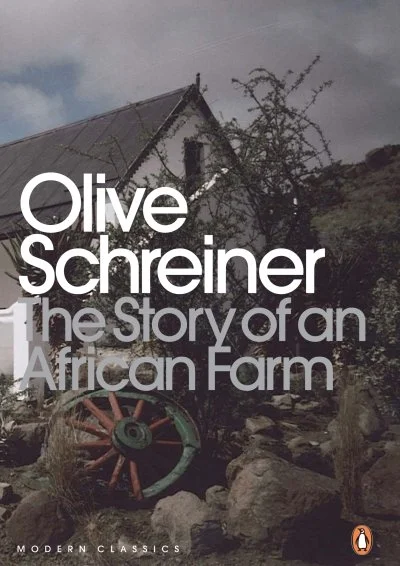
‘Olive Schreiner’s Spatial Narratives: Resisting Patriarchy and Empire from the Margins.’ Politics of Place, Issue 01: Maps and Margins (August 2013), pp.25-39
This article explores how Olive Schreiner’s self-conscious meta-narratives illustrate a powerful historiographical awareness that challenges patriarchal and imperialist grand narratives. She acknowledges her debt to metropolitan intellectual discourses while emphasising their limitations. The spatial disjunction of her location in the South African periphery allows her to unravel the narratives that cloak the realities of a violent, male-dominated colonialism. Through close readings of her novel, The Story of an African Farm, alongside other essays and writings, the article argues that Schreiner was a “resistance writer” many decades ahead of her time.