

From housing and transport to sanitation and energy systems, TTiN understands infrastructure as the foundational and often contradictory material that unevenly distributes vital resources, including not least the resource of life itself. It sees infrastructure as the site where forms of oppression are reproduced and contested, and where new kinds of liberation might be fought for and realised.
Though engaged with its technical and economic underpinnings, TTiN refuses a deterministic approach to infrastructure and pays close attention to its social, cultural, and emotional aspects. Network participants think about infrastructure, but they also think through infrastructure to ask how it shapes lived experience and both curtails and enables our political imaginations.
The full TTiN website is available here. Follow the TTiN podcast on Soundcloud, Apple, or Spotify, or listen back at the episode links below. Future activities are posted to the network’s Instagram and Bluesky profiles.
-
Less is Not Enough: Minimalist Desires and Postgrowth Politics, with Miriam Meissner, Dom Davies, and Postgrowth Planning at UCL Bartlett
From decluttering bedroom drawers to detoxing from social media, minimalism has taken the global affluent class by storm. But what are the cultural politics of minimalist practices? Are they just an online trend or do they foster deeper desires that might be mobilised in the pursuit of a just world after capitalist growthism? And is It possible to speak of Marie Kondo as an organic intellectual of the globally affluent? This episode presents an event hosted by the UCL Bartlett’s Postgrowth Planning Group to celebrate the publication of Miriam Meissner’s new book, Less is Not Enough: Minimalist Desires and Postgrowth Politics. Trends like decluttering and mindfulness depoliticise middle-class frustrations with capitalist exploitation. Through a critical analysis of self-help books, TV shows, and online communities, Less Is Not Enough argues that while minimalism is often a distraction from the root causes of the very problems it seeks to alleviate, it also contains the seeds of a more radical cultural politics that might build popular consent for postgrowth planning strategies.
-

Missiles on the Machair: Military Infrastructures in the Scottish Hebrides, with Zsuzsanna Ihar
Where is Britain’s military infrastructure? Who builds it and how does it reshape rural landscapes? What happens to the communities who must learn to live in its vicinity? How are they persuaded to accept it? How do they resist? Whose labour makes military infrastructure work and how is it connected to conflicts around the world? In this episode, Dom spoke with Zsuzsanna Ihar, an anti-disciplinary historian and anthropologist, about her research into the roll out of military infrastructure in the Uist, a group of six islands in the outer Hebridean archipelago. The conversation covered the rise of critical military studies, the continuities between the Highland clearances and the later establishment of military infrastructures, the dubious promise of dual use technologies and the recruitment of disadvantaged communities into the military industrial complex, and the ongoing construction of a new space port at Britain’s northernmost edges.
-

Gentrification and the African Presence in Peckham Walking Tour, with Charmaine Brown
This episode presents an audio recording of the Gentrification and African Presence in Peckham or GAPP walking tour, led by Dr Charmaine Brown. The tour highlights key spaces in Peckham occupied by the Caribbean community from the 1950s through to the 1990s and early 2000s. It also explores how Peckham has been reshaped by waves of gentrification in the years since. Photographs from along the route of the tour, including its different stops, are available on the Thinking Through Infrastructure Instagram page, which you can find @TTinfraNetwork. We recommend making use of these visual aids as you listen. Dr Brown is a London-based educator from Kingston, Jamaica. For more information about her work, or if you would like to contact her about leading another tour, please head to www.drcharmainebrown.com.
-

Electric Wind: An Energy History of Modern Britain, with Marianna Dudley
What is wind? How do we transform wind into electricity? And how does a view of Britain from the vantage of wind energy change our narrative of its national history and its national geography as well? In this episode, Dom spoke with Marianna Dudley, Senior Lecturer in the Environmental Humanities at the University of Bristol, about her recent book Electric Wind: An Energy History of Modern Britain (MUP 2025). The discussion explored the connections between wind energy and the welfare state, what wind has to do with Thatcherite ideology, the cultural politics of NIMBY resistance to wind turbines, and the limits of GB Energy. This is a recording from a live event hosted in collaboration with SPARC (Sound Practice and Research at City St George’s), as well as City’s Modern History Cluster. Excerpts from SPARC co-director Claudia Molitor and writer Jessica J. Lee’s audio exhibit, “1000 words for weather,” feature throughout the episode.
-
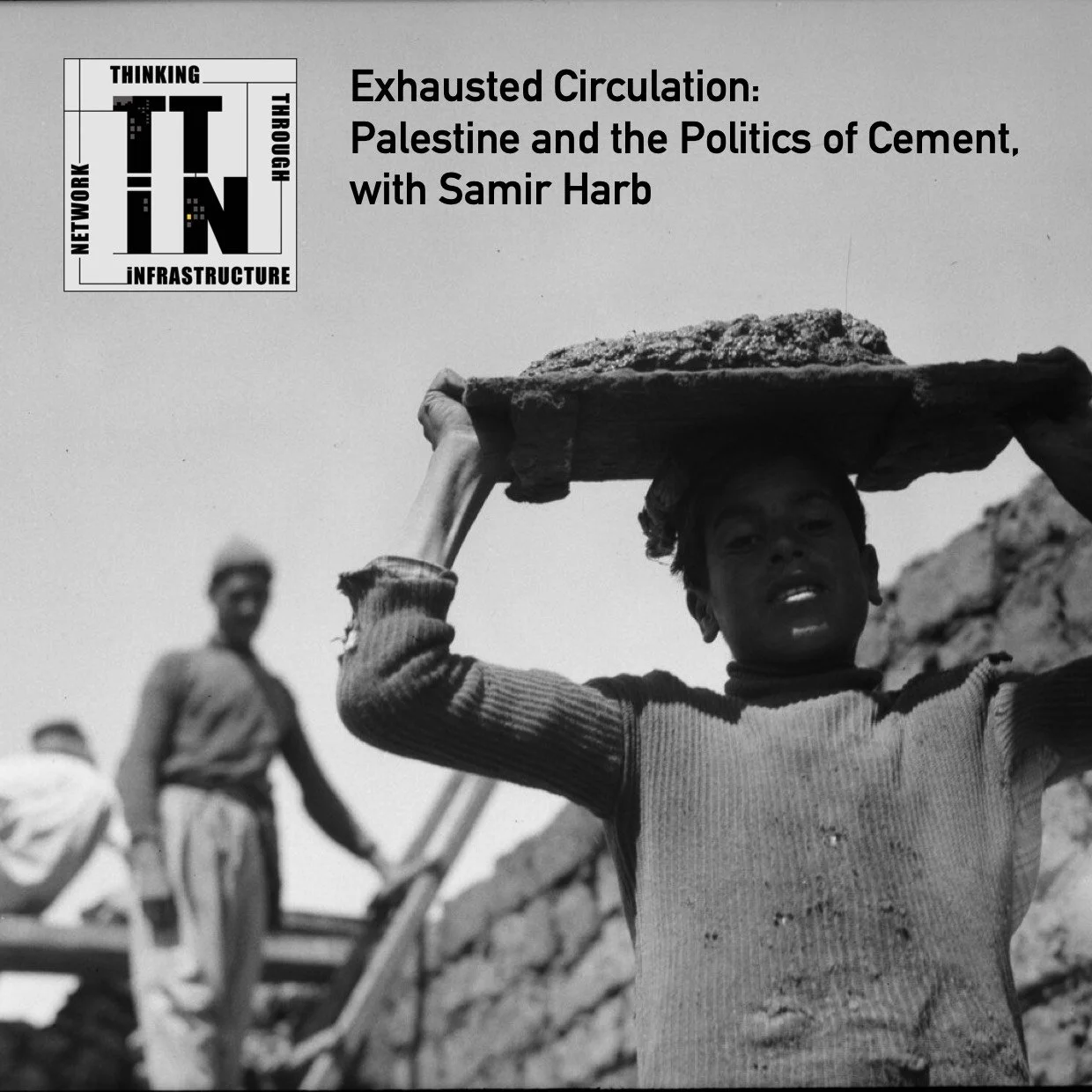
Exhausted Circulation: Palestine and the Politics of Cement, with Samir Harb
Concrete underpins modern construction. But where does the cement that comprises concrete actually come from? What natural resources, state territories, power relations, and political ecologies does cement bring into view? And how are the stakes of these ecologies raised in the fraught space of Palestine? In this episode, Dom spoke with Samir Harb, a trained architect, human geographer, comics maker, and artist to discuss his research into the politics of cement in occupied Palestine. The conversation covered Samir’s early training as an architect in the West Bank, how the circulation of cement exhausts the metabolism of Palestinian cities, why Samir has used comics to explore the territorial contradictions of the Israeli occupation, and why he has turned to art in response to the genocide in Gaza.
-

Logistics and Power: Supply Chains from Slavery to Space, with Susan Zieger
Logistics describes the just-in-time supply chains that make consumer capitalism possible in the twenty-first century. It has seeped into every corner of our imaginations and behaviours, transforming us into logistical subjects who must manage our lives through the systems and schedules of late modernity. But where does logistics come from? What are its pressure points and paradoxes? And how does it shape our culture and society? In this episode, Dom sat down with Susan Zieger to discuss her latest book, Logistics and Power: Supply Chains from Slavery to Space. The conversation covered just some of the book’s many supply chain stories, which show us how logistics blur the lines between peace and war, and how counter-logistics can create more human spaces in a world that is otherwise governed by commodity power.
-
Cartographies of Empire: The Road Novel and American Hegemony, with Myka Tucker-Abramson
DescriptiWhat makes an American road novel? What are the material conditions that caused it to emerge in the mid-twentieth century? Why does it persist, what does it tell us about infrastructure, and why has it travelled so widely – but also unevenly – through literary cultures across the globe? In this episode, Dom sat down with Myka Tucker-Abramson to discuss her recent book, Cartographies of Empire: The Road Novel and American Hegemony. Drawing on an archive of more than 140 road novels, Myka asks what this seemingly straightforward genre can tell us about the hopes, contradictions, and disappointments of infrastructure as it has been scripted in the US and across its informal empire.
-
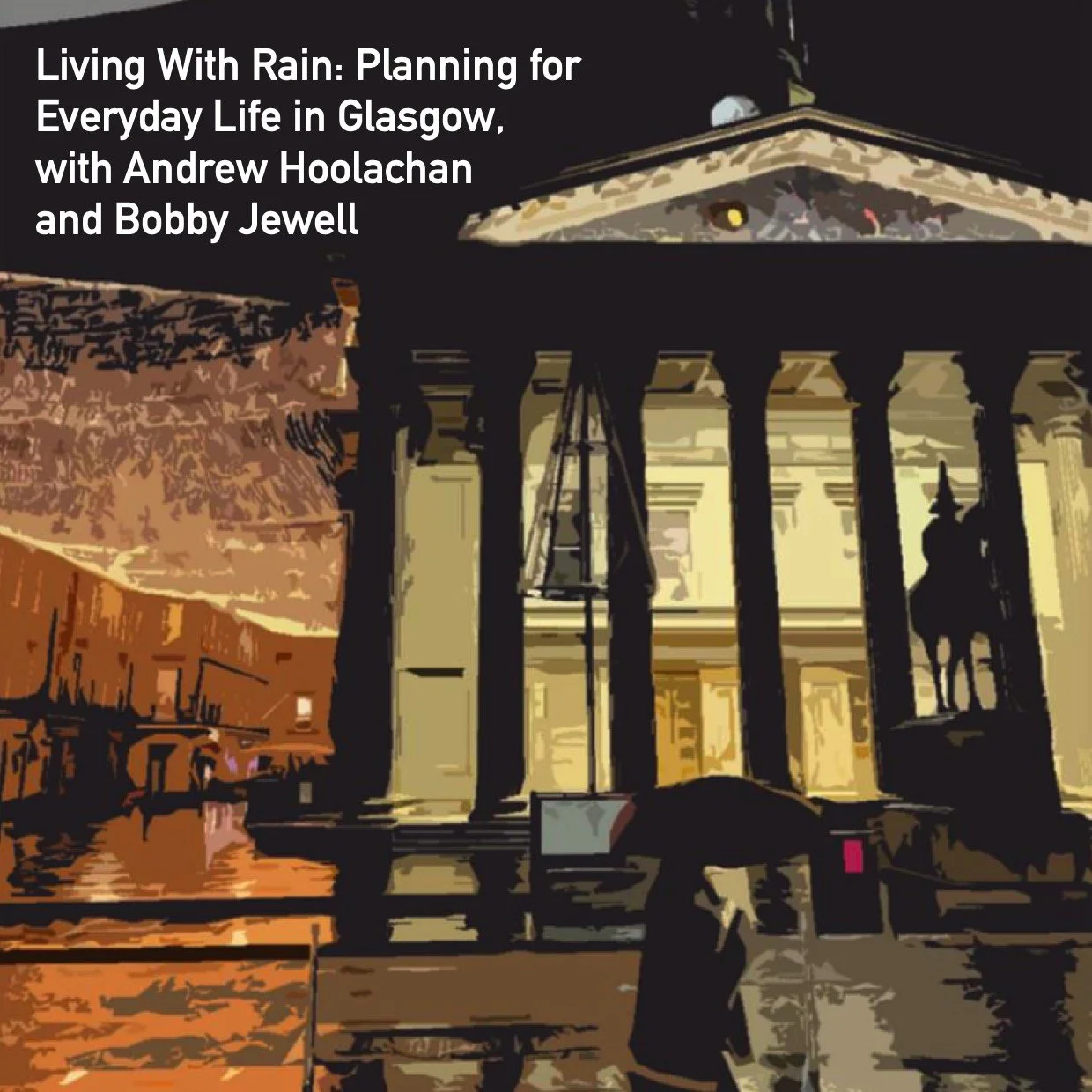
Living With Rain: Planning for Everyday Life in Glasgow, with Andrew Hoolachan and Bobby Jewell
How does rain impact how and when people get around, whether on foot, on public transport, or in private vehicles? How does it affect how we use outdoor and public spaces, from parks to streets and shopping centres? How does rain reveal faults or failures in our infrastructure? And how might we redesign our cities in ways that allow us to embrace and live with rain? Dom sat down with Andrew Hoolachan, a Lecturer in Urban and Regional Planning at the University of Glasgow, and Bobby Jewell, an architectural communications consultant, sound artist, and writer based in Glasgow. We discussed Andrew’s Living With Rain report and Bobby’s exhibition and album You Are Not Made Of Sugar.
-
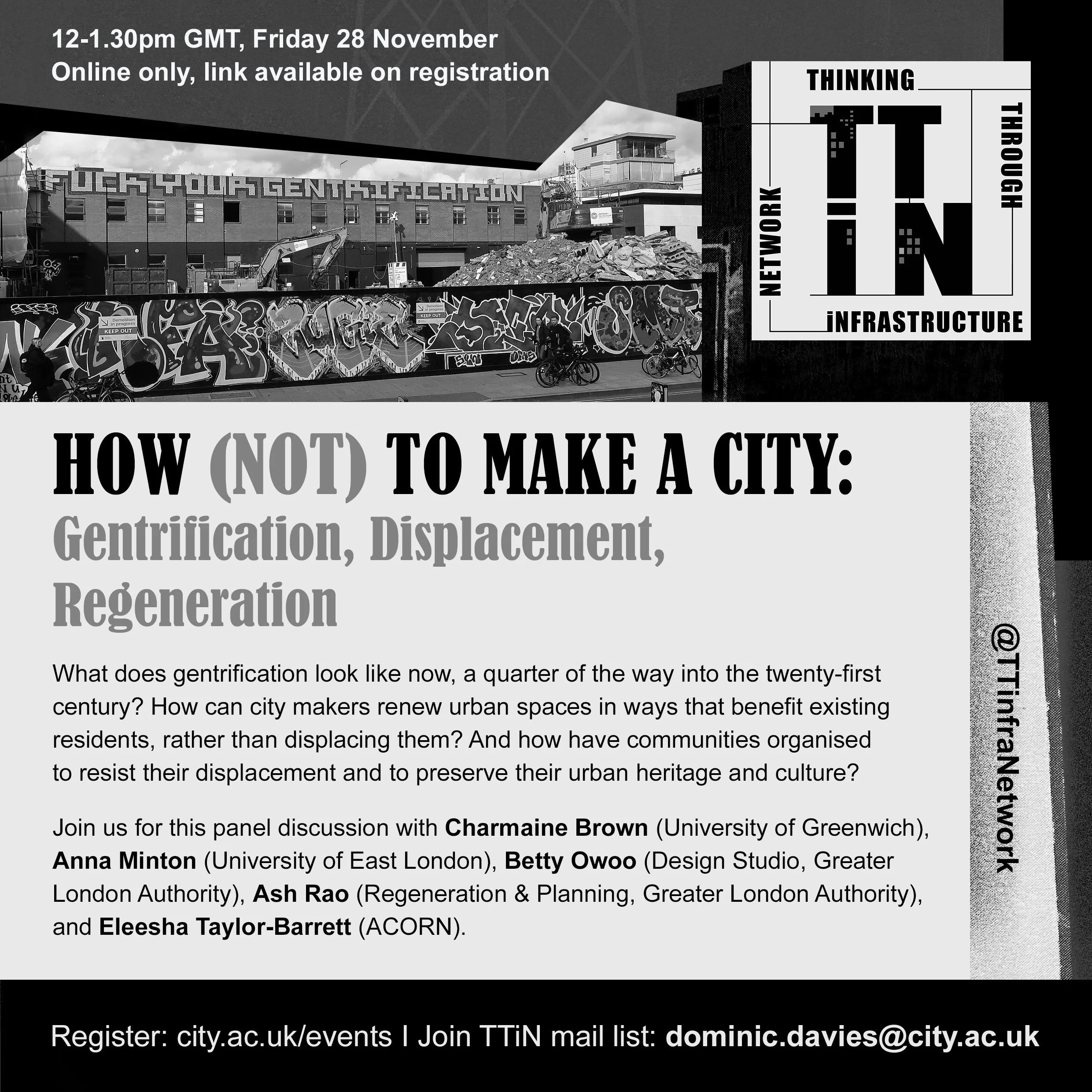
How Not to Make a City, with Charmaine Brown, Anna Minton, Betty Owoo, and Ash Rao
How can city makers renew urban spaces in ways that benefit existing residents, rather than displacing them? And how have communities organised to resist their displacement? On 28 November, TTiN put these questions and more to a panel of academics and practitioners: Charmaine Brown, community activist in Peckham and Lecturer at the University of Greenwich; Anna Minton, journalist, author, and Reader at the University of East London; Betty Owoo, Senior Design Officer in the Greater London Authority's Design Unit; and Ash Rao, urban designer and planner on the GLA’s Regeneration and Planning team.
-

Thirst: Solving the Global Water Crisis, with Filippo Menga, Naho Mirumachi, and Julie Froud
What would you say if you had 5 minutes to talk to Matt Damon about the “global water crisis”? On 18 October, TTiN hosted Filippo Menga for a conversation about this and other questions addressed in his book, Thirst: The Quest to Solve the Global Water Crisis (Verso 2025). With responses from Naho Mirumachi, Professor in Environmental Politics at King's College London, and Julie Froud, Professor of Financial Innovation at the University of Manchester, this session explored Filippo’s groundbreaking account of the global water crisis and the failure of corporations and non-profits to address its worsening effects.
-
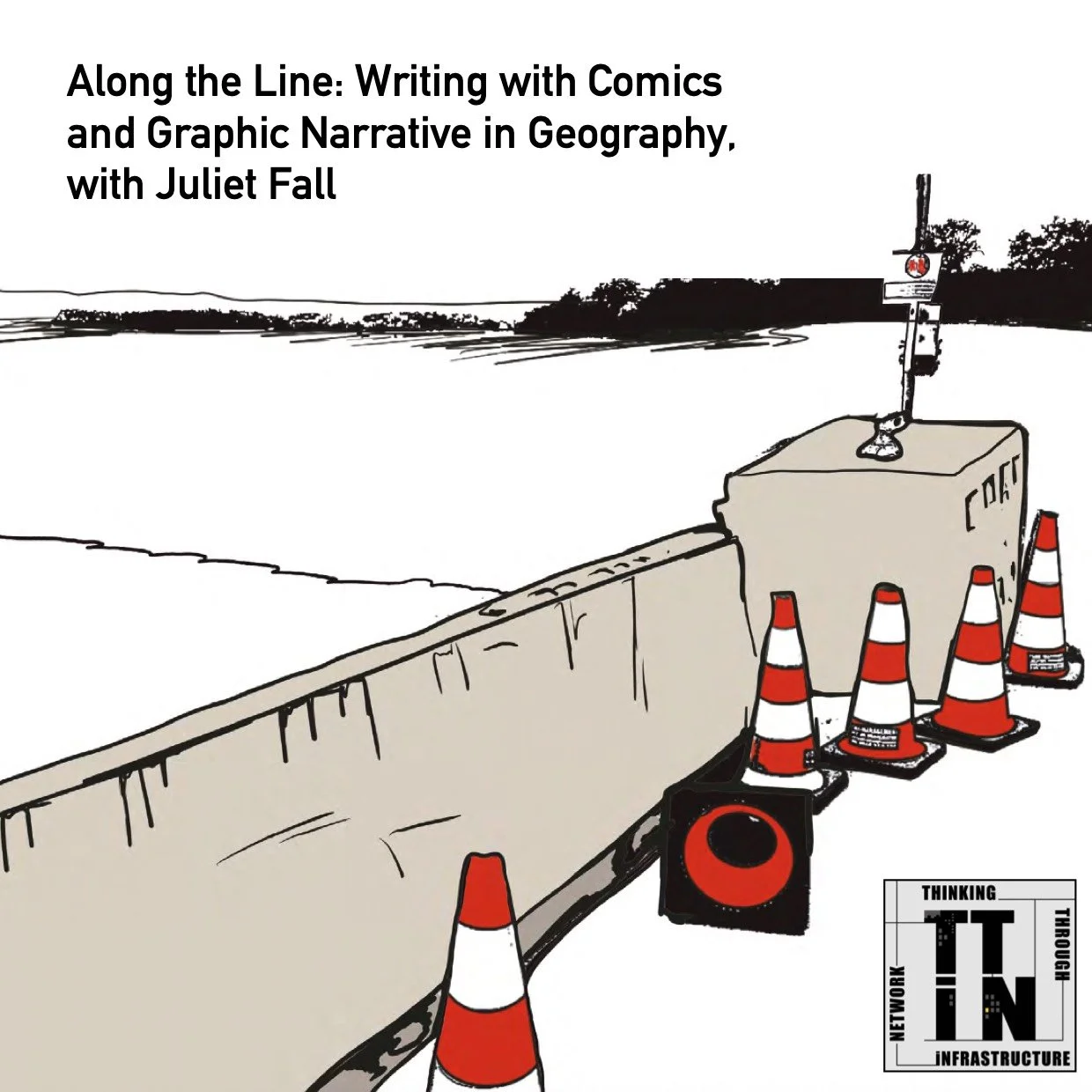
Along the Line: Writing with Comics and Graphic Narratives in Geography, with Juliet Fall
Professor Juliet Fall is a political and environmental geographer at the University of Geneva in Switzerland. Juliet’s work focuses on questions of border infrastructure, biosecurity, and the boundaries between humans and nature. In this podcast, we discussed her new book, Along the Line: Writing with Comics and Graphic Narrative in Geography, which interleaves ethnographic comics with academic essays. Our conversation explored what it means to research infrastructure through drawing, the layered histories of borders in Europe, and the way both infrastructure and drawing mediate between scales of the abstract and the intimate.
-
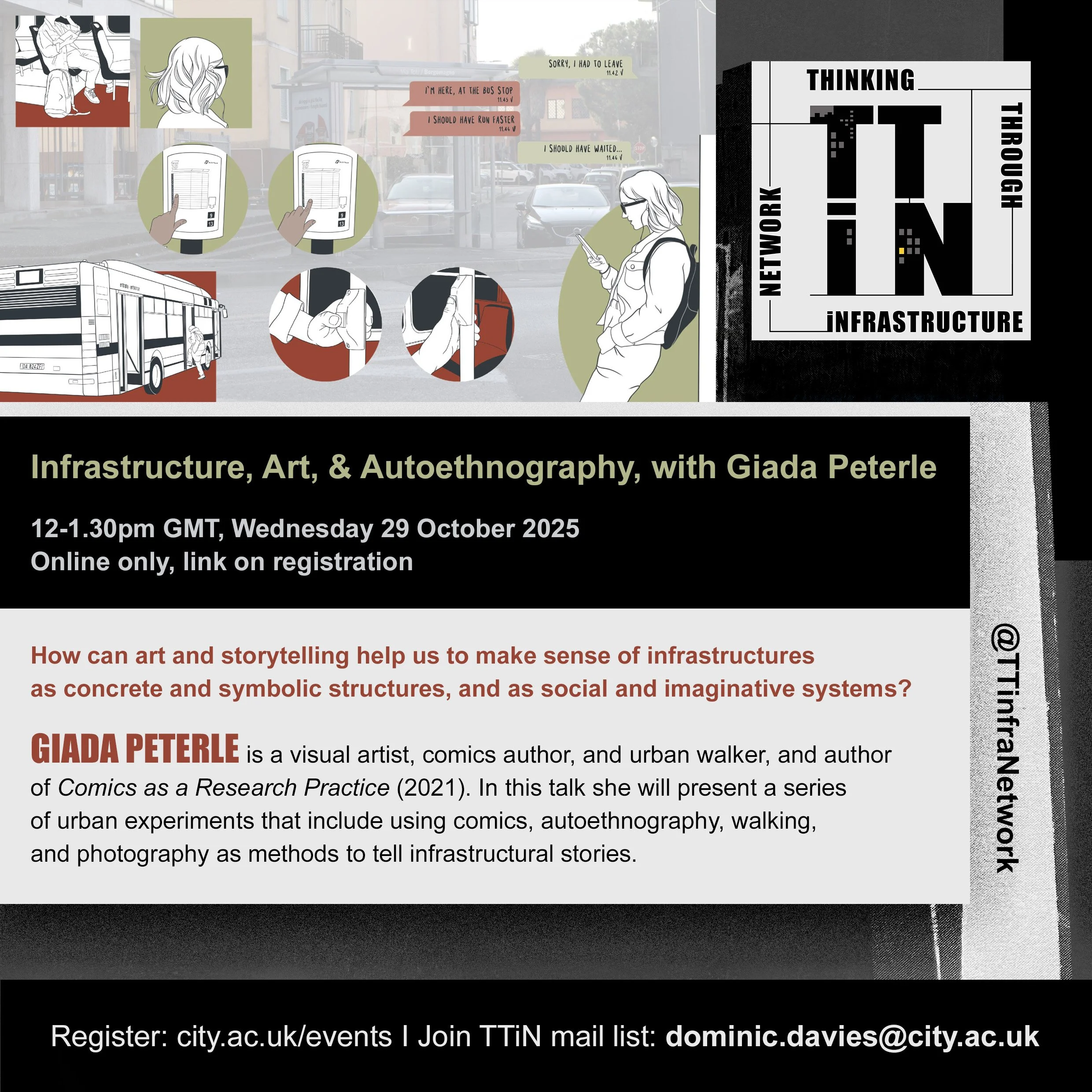
Infrastructure, Art, and Autoethnography, with Giada Peterle
How can art and storytelling help us to make sense of infrastructures as concrete and symbolic systems? How do we map the social, cultural, and imaginative aspects of infrastructure? Giada Peterle is a visual artist, comics author, and urban walker, and author of Comics as a Research Practice (2021). Her work explores how arts-based and narrative approaches can expand the ways we think through and with infrastructures. She experiments with creative mapping practices that include comic book cartographies and geoGraphic narratives. In this talk, Giada presents a series of urban experiments that use comics, autoethnography, walking, and photography as methods for telling infrastructural stories.
-

Railway Infrastructure and the Victorian Novel, with Nicola Kirkby
Dr Nicola Kirkby is Centre Manager for DIVERSE CDT, the EPSRC Centre for Doctoral Training in Diversity in Data Visualization, at City St George’s, University of London, and a member of the steering group for the Thinking Through Infrastructure Network. In this podcast she discusses her new book, Railway Infrastructure and the Victorian Novel: From Platform to Plot via the Railroad, which is out now with Cambridge University Press. The conversation explores the different ways that rail infrastructure has reshaped the novel as the nineteenth century progressed, and asks how close reading can help us to see and think differently about the social and cultural impact of infrastructure. There’s also some healthy Raymond Williams stanning.
-
City Fictions of the New India, with Alex Tickell, Ruvani Ranasinha, and David Johnson
Professor Alex Tickell is a historian and critic of global literatures in English. This panel event launched his book, City Fictions of the New India, published in 2025 by Oxford University Press. In the book and this recorded discussion, Alex discusses how fiction, literary journalism, the graphic novel, and television drama have reimagined the relationship between infrastructure and citizenship in contemporary Indian cities. Alex is in conversation with Professor Ruvani Ranasinha (King's College London) and Professor David Johnson (Open University).
-
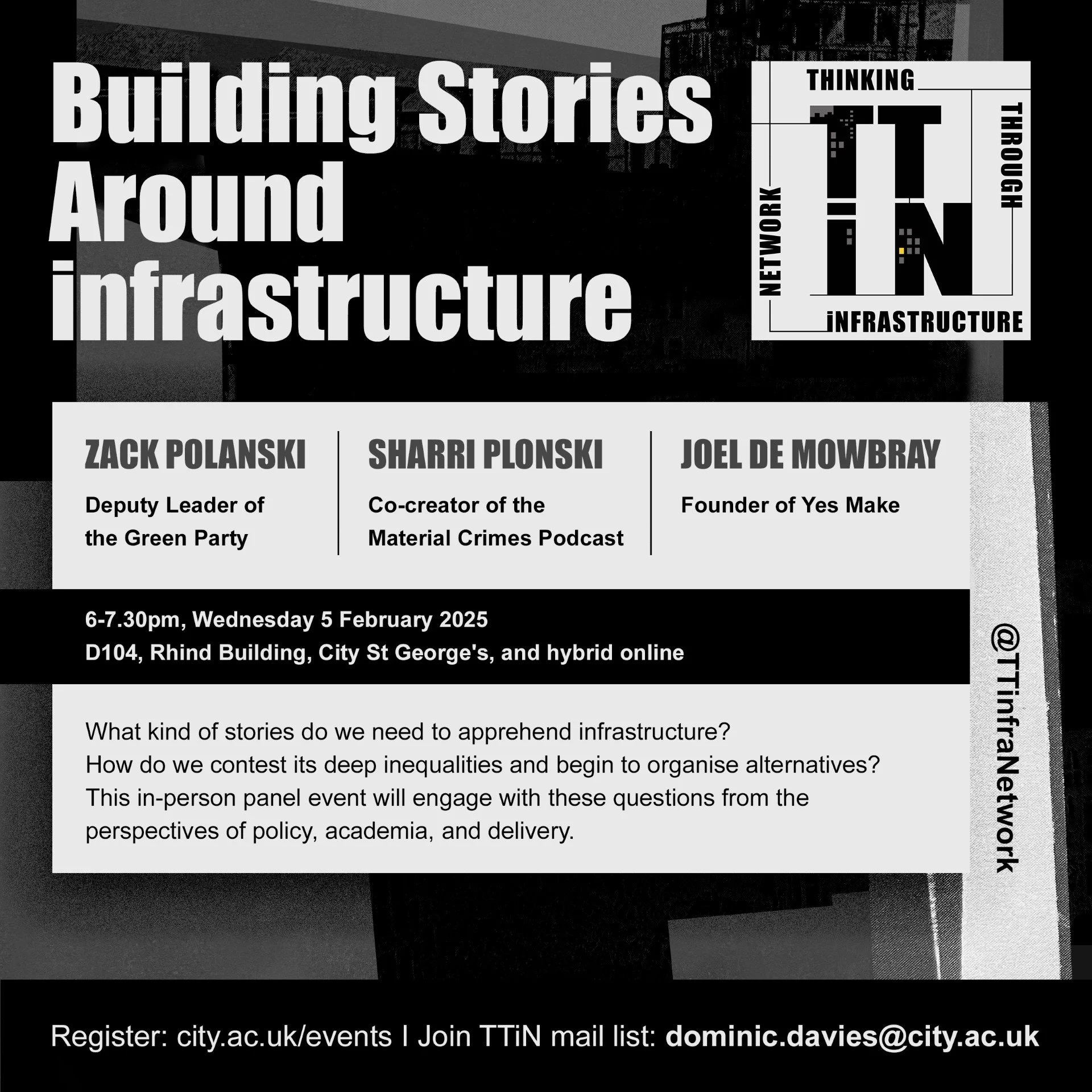
Building Stories Around Infrastructure, with Zack Polanski and Joel De Mowbray
Infrastructure is comprised of systems or networks so complex that we can never see them in their physical totality. Yet they also shape the most immediate conditions of our lived experience, unevenly redistributing wealth, time, and life itself across society. What kind of stories do we need to apprehend infrastructure? How can we see it and bring it under our collective control? How do we contest its arrangement of deep inequalities and begin to organise around alternatives? Chaired by Dom Davies, this discussion is led by Zack Polanski, Deputy Leader of the Green Party and Member of the London Assembly, and Joel De Mowbray, founder of Yes Make, an infrastructure delivery organisation that specialises in empowering communities through the construction of public spaces, with members of the Thinking Through Infrastructure Network.
-
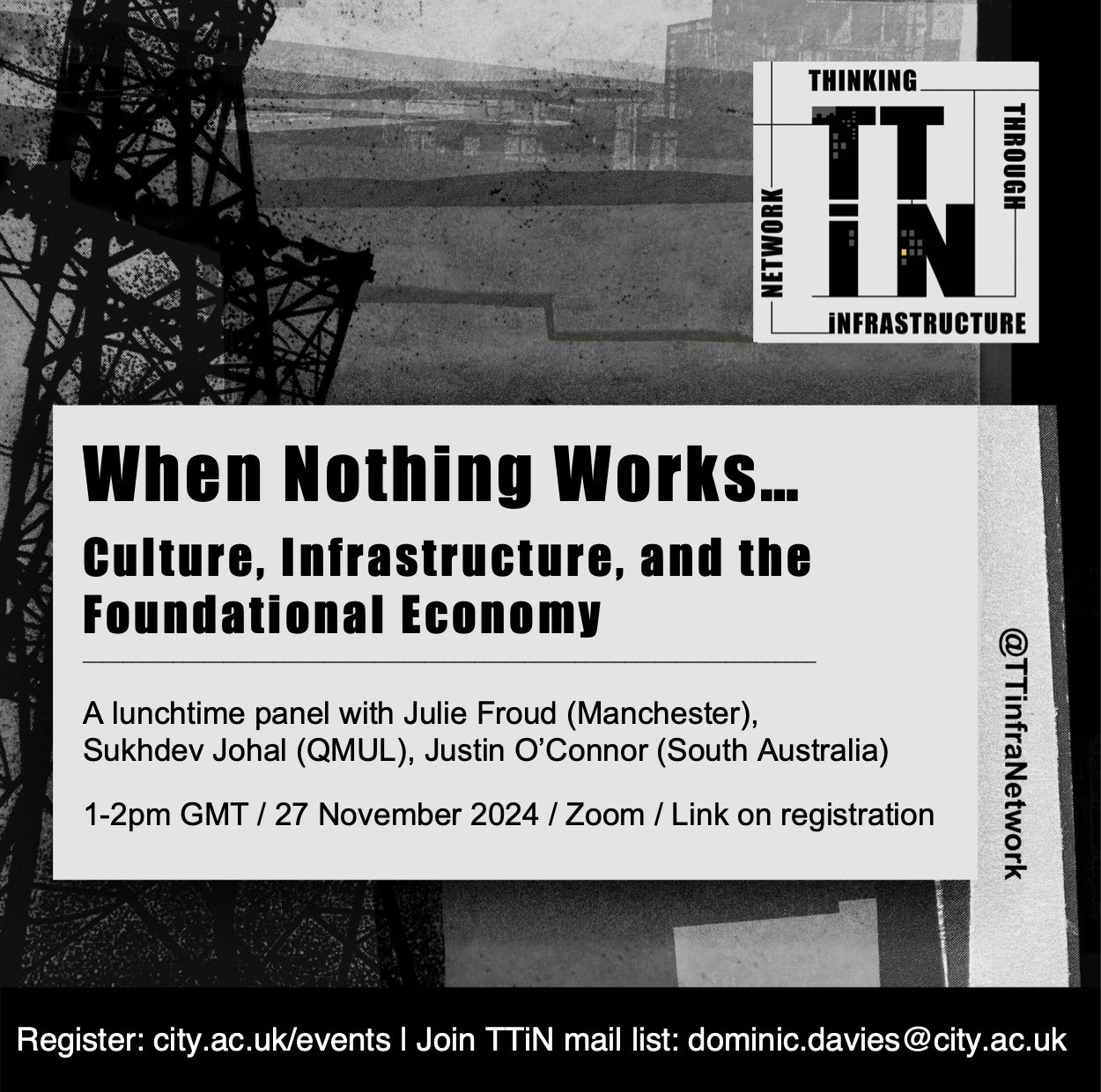
When Nothing Works, with Julie Froud, Sukhdev Johal, and Justin O'Connor
It's hard to escape the feeling that in Britain today nothing works. Economic growth and higher wages are simply not enough. This is because the so-called "cost of living crisis" is only the face of a deeper crisis of foundational liveability. How can we address failing public services and decaying social infrastructure? What is the foundational economy and how do we rebuild it? What is the role of cultural infrastructure in this process? On this lunchtime panel, Julie Froude (Manchester) and Sukhdev Johal (QMUL), members of the Foundational Economy Collective and two co-authors of When Nothing Works (2023), discuss these questions alongside Justin O'Connor (South Australia), author of Culture of is Not Industry (2024).