Preface to the Korean Edition of Imperial Infrastructure
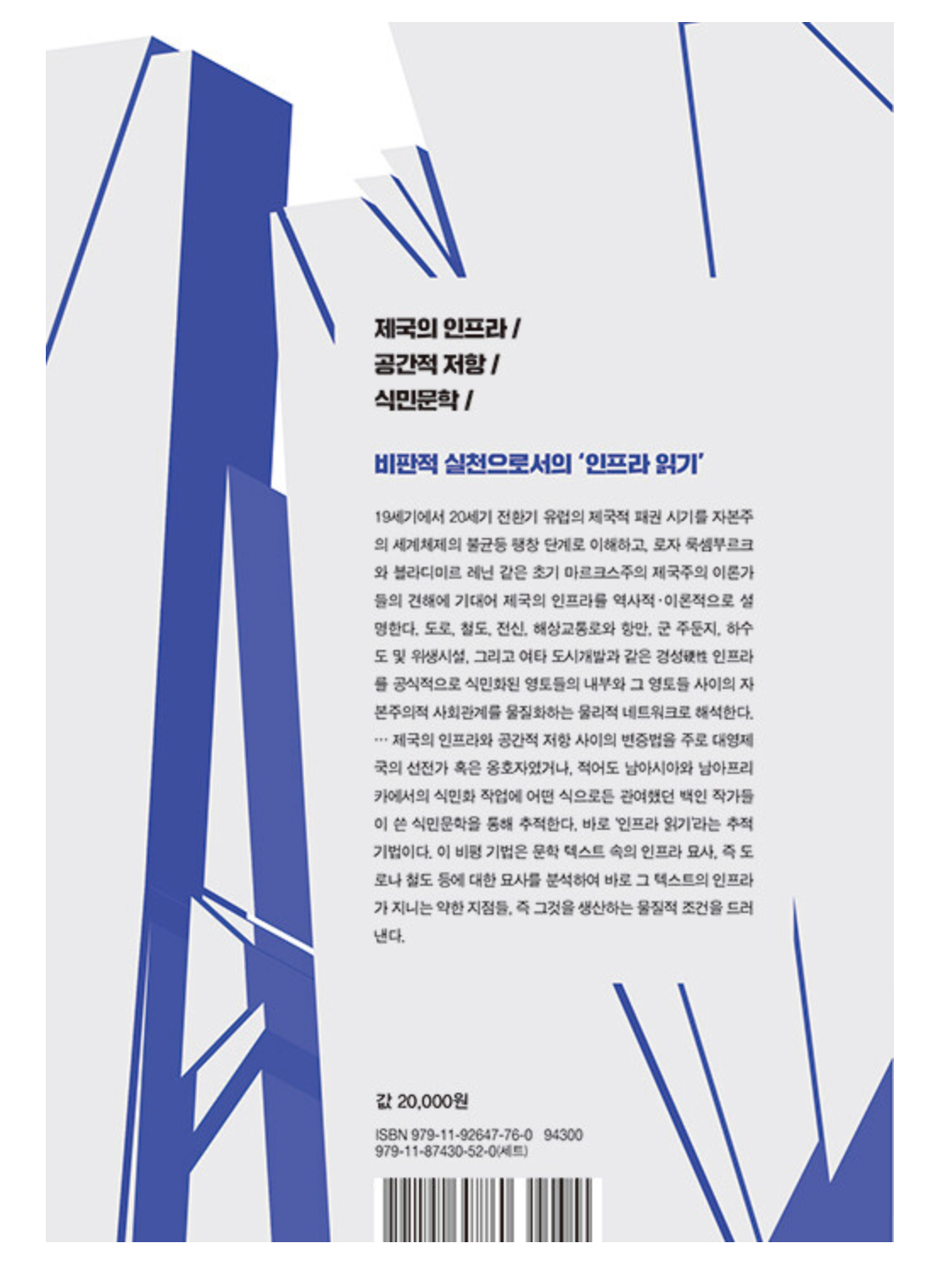
I’m grateful to Professor Jinhyoung Lee at Konkuk University’s Academy of Mobility Humanities in Seoul, South Korea, for supporting a Korean translation and new edition of my first book, Imperial Infrastructure and Spatial Resistance in Colonial Literature, 1880-1930. It’s a beautiful object and I wrote a preface to mark it. This is reproduced below.
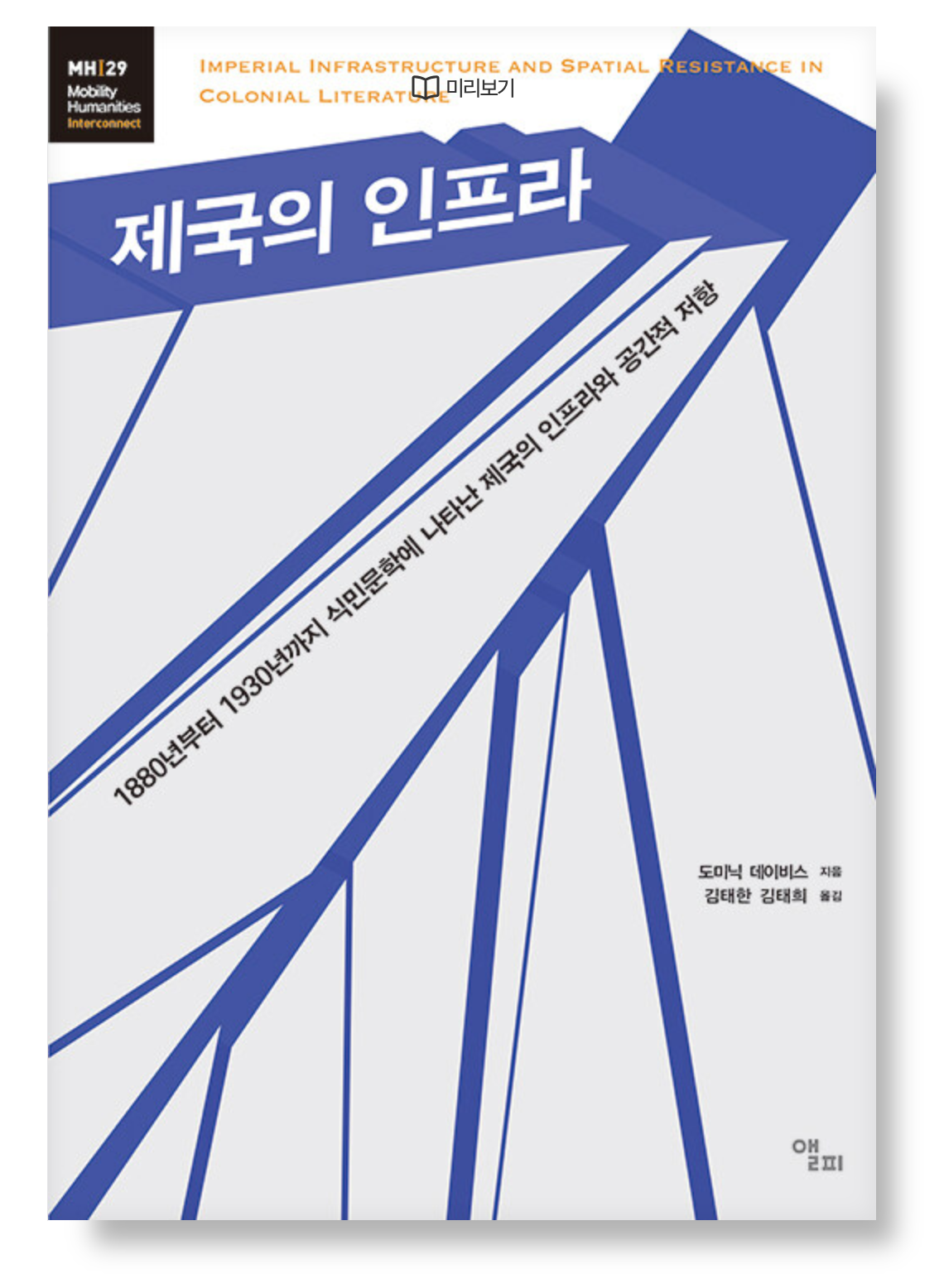
Let me begin this short preface by extending my gratitude to Professor Jinhyoung Lee and his team at Konkuk University’s Academy of Mobility Humanities in Seoul, both for their interest in Imperial Infrastructure and for initiating its translation into Korean. I am grateful also to Laurel Plapp, the rights team at Peter Lang, and Bestun Korea Agency for facilitating this edition. This book was the culmination of eight years of research, worked out first through a Masters dissertation and PhD thesis, and then revised again into its original English publication in late 2017. Now another eight years have passed and it is rewarding to know this translation will make its contents available to an entirely new audience.
Any scholar who looks back on their work with nearly a decade’s hindsight will immediately notice the imperfections in their theory and argumentation, and my view of Imperial Infrastructure is no exception. But such distance can also allow a scholar to better understand the position of their work in the trends of critical theory and academic study, and to see with greater clarity what was distinct about their contribution. This is particularly the case for a book that wedded infrastructural analysis with literary studies, a tendency that in 2017 was still in formation, but which has since established itself at the intersection of fields such as mobility studies and the environmental humanities and also become its own deserving subject of concern.
By way of an introduction to this translation, I will therefore take a few paragraphs to reflect on the way the disciplinary origins of Imperial Infrastructure shaped what I still see as its main conceptual offering, the notion of “infrastructural reading” as a critical practice. I will also briefly situate the book in the context of scholarship in the “infrastructure humanities” that has emerged subsequent to its publication and include a final note for Korean readers.
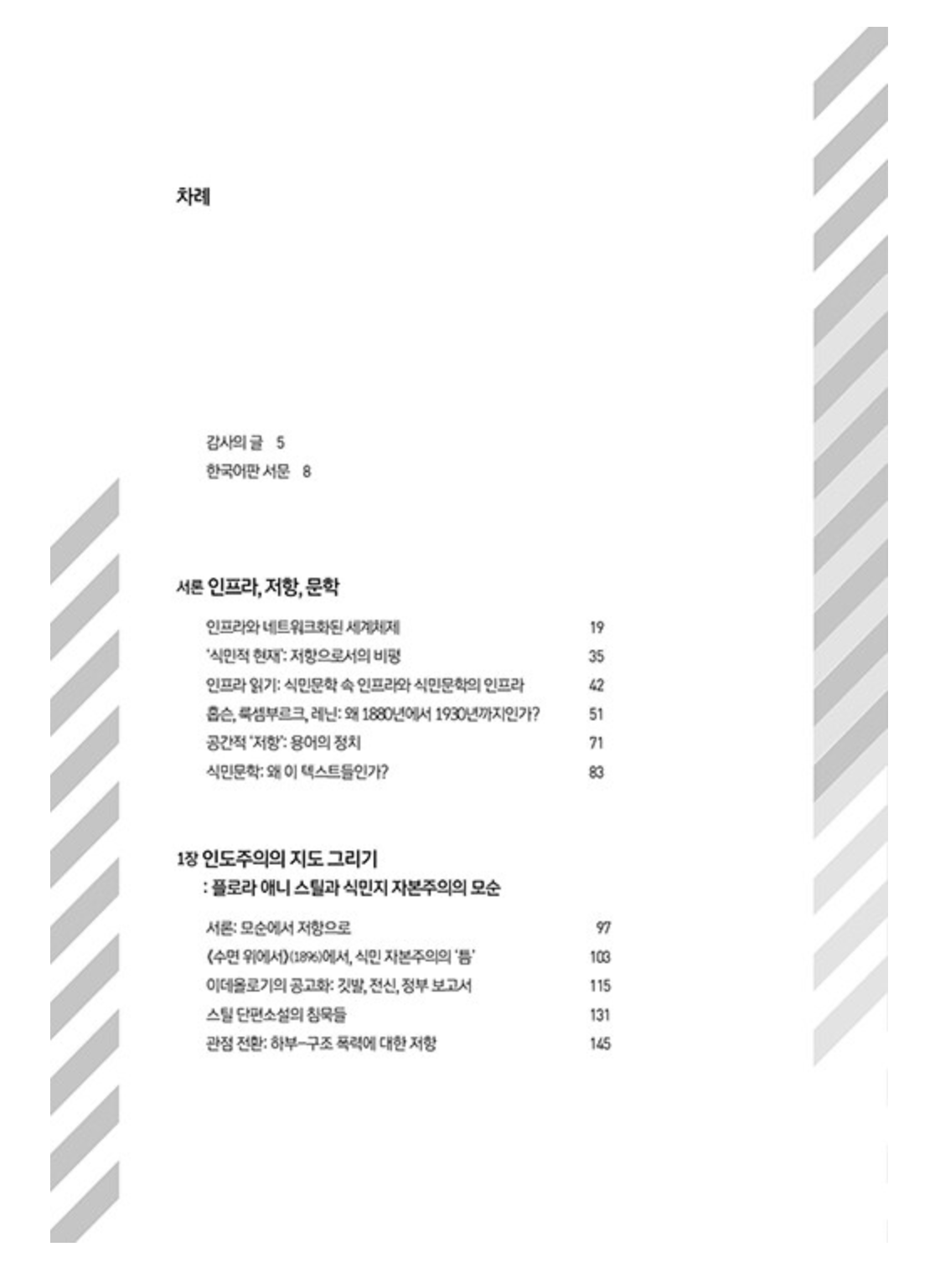
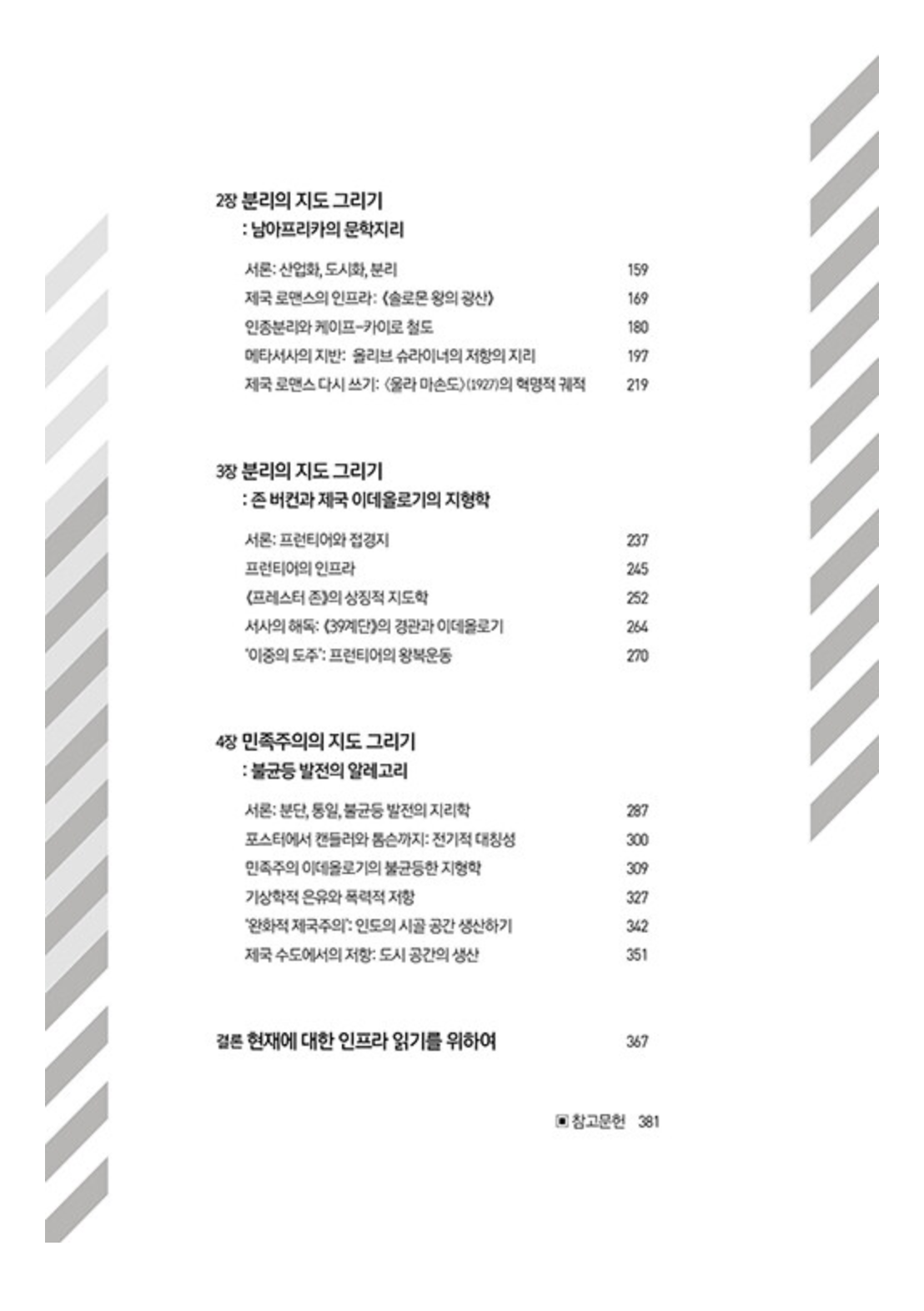
The book makes three distinct scholarly interventions, captured in the three couplets included in its full title, Imperial Infrastructure and Spatial Resistance in Colonial Literature, 1880-1930. In its first contribution, it draws on early Marxist theorists of imperialism like Rosa Luxemberg and Vladimir Lenin to provide a historical and theoretical account of imperial infrastructure. I insist that the period of European imperial hegemony at the turn of the twentieth century should be understood as a phase in the uneven expansion of the capitalist world-system. I read hard infrastructures – roads, railways, telegraphs, shipping lanes and ports, military cantonments, sewerage and sanitation systems, and other urban developments – as the physical networks that materialised capitalist social relations both within and between formally colonised territories.
In its second contribution, the book sets out to map different kinds of resistance to this imperial infrastructure, by emphasising the spatiality both of openly violent and non-violent forms of anti-colonial insurgency, and also by extending this definition to encompass the spatial contradictions that are generated by capitalism’s uneven development. Spatial resistance therefore includes material contradictions, such as the concentration of labour at chokepoints in the world-system, and also cultural ones, such as the loss of the colonial fantasy of the frontier as a redemptive landscape that would resolve the domestic tensions – both social and environmental – in the metropolitan heartlands of empires such as Britain’s.
Third and finally, the book tracks this dialectic between imperial infrastructure and spatial resistance through colonial literature written by white writers who were mostly propagandists or apologists of the British Empire, or who were at least involved in some way in its colonising operations in South Asia and southern Africa. It describes this tracking technique as “infrastructural reading,” a method of critique that analyses the infrastructures in literary texts – their representations of roads, railways, etc. – to reveal the weak points in the infrastructures of those same texts – that is, the material conditions of their production. My aim with infrastructural reading was to turn colonial literature into a contrapuntal map of imperial power, one that showed how the global expansion of infrastructure through the half century between 1880 and 1930 was bound both materially and imaginatively to the British Empire’s growing instability and eventual dissolution.
It’s important to note that I approached the question of infrastructure from my background in literary studies and, more specifically, the tradition of colonial discourse analysis that had been a central plank of postcolonial critique through the 2000s. Imperial Infrastructure was written in the vein of materialist criticism that sought to ground the more culturalist and identitarian strands of postcolonial studies by foregrounding the imperatives of profit and exploitation that motored capitalism as a distinctly world-system. Indicatively, the Warwick Research Collective’s Combined and Uneven Development, which also drew on Immanuel Wallerstein to develop a theory of “world-literature,” came out in 2015, the year I finished the thesis and two years before Imperial Infrastructure was published. However, if the book emerged alongside this material turn in world-literary studies, it is not straightforwardly “of” it: there remains in Imperial Infrastructure an earlier postcolonial commitment to rereading the colonial archive and to the value that field placed on terms like “resistance” and “contrapuntal reading.” These concepts were derived from the writing of Edward Said (especially Culture and Imperialism, 1993), who was always concerned to show how the legacies of the British Empire were still very much alive in the present, not least in the plight of the Palestinians. If Imperial Infrastructure is therefore an attempt to reinvigorate Marxist approaches to the history of high empire, it was also interested in the way infrastructures built by colonial powers continued to reproduce material inequalities long after formal decolonisation.
It was in the early 2010s that the first string of articles and books that read for infrastructure in literary texts started to emerge (Rubenstein 2010; Beale 2013; Rubenstein et al. 2015). Many of these were notably concerned with colonial and postcolonial contexts where infrastructure was “visible” because it was either projecting imperial power or collapsing into disrepair. This uptake in literary studies had filtered through from a longstanding concern with infrastructure in urban studies (Simone 2004; Graham 2010), and which was being amplified in turn by exciting anthropological and ethnographic work that really got underway throughout the 2010s (Harvey & Knox 2015; Anand et al. 2018). This strand of infrastructural analysis tended to be interested in the affective and experiential contours of infrastructure, and this gripped the imagination of scholars working in literary and cultural studies, including my own, such as in my co-edited collection with Elleke Boehmer, Planned Violence: Post/Colonial Urban Infrastructure, Literature, and Culture (2018), and my more recent book, The Broken Promise of Infrastructure (2023), which is in many respects a sequel to Imperial Infrastructure. Interest in infrastructure also grew as humanities scholars became increasingly concerned with the climate crisis and began to take particular interest in fossil fuels and other forms of energy production (Johnson & Nemser 2022). With time, this has consolidated into a field that some have termed the “infrastructure humanities,” with scholars across the disciplines reading everything from logistics networks and digital platforms to installation artworks and advertisements through the productive lens of infrastructural analysis (Rich et al. 2022; Pinnix et al. 2023).

While all of this exciting work around infrastructure has certainly been attuned to the violence of capitalist underdevelopment, it has often taken place under the umbrella of the environmental humanities and has therefore not always been framed in the explicitly Marxist and anti-imperialist terms that were my concern in Imperial Infrastructure. Looking back at it now, it therefore seems to be this that might mark out the book’s unique contribution. The notion of “infrastructural reading” is really about taking hold of concrete moments of violence in the colonial periphery and showing how those spatial conflicts refract much larger convulsions and pressures in the wider world-system. Literature is not incidental to this configuration; indeed, infrastructural reading is intended primarily as a way of seeing infrastructure differently through literature. It shows how the literary allows us access to moments of system failure and political dissent that are otherwise effaced from imperial maps and colonial archives. Its Marxist grounding means that it never loses sight of the fact that infrastructure is ultimately a manifestation of capitalism’s economic power, while its postcolonial commitments seek to bring back into view the antagonism and agency of the colonised that inevitably imprinted itself onto the built forms of empire. Even if this resistance is not always immediately visible, infrastructure was often built to subdue anti-imperial activity, just as its construction was often deterred or redirected by anti-colonial insurgency. It is in this sense that infrastructural reading is closer in practice to the historiographic project of the Subaltern Studies Group – who, it is often forgotten, had both anti-colonial and Marxist commitments – than it is to the primarily ethnographic or formal methods that dominate infrastructure studies today.
The book’s geographical scope is contained to the British Empire across southern Africa and South Asia. It does not extend to the many projects that were pursued in other parts of Asia, and it only briefly considers the way “imperial infrastructure” might continue to travel under different articulations of colonial power in the twenty-first century. Nonetheless, the conclusion of the book explicitly looks towards “an infrastructural reading of the present” and calls on others to think of ways that its methods might be applied to different times and spaces throughout the world-system. If there is much that is unfinished in Imperial Infrastructure, and much I would write differently now, it is my hope that Korean readers will still find something in its overriding insistence that infrastructure is at once a violent weapon of empire and the point at which the contradictions of capitalism can become suddenly, empoweringly visible.
Dominic Davies, United Kingdom, 1 September 2025

Bibliography
Anand, Nikhil, Akhil Gupta, and Hannah Appel eds. 2018. The Promise of Infrastructure. Durham & London: Duke University Press.
Beale, Sophia. 2013. Brazil Under Construction: Fiction and Public Works. New York: Palgrave MacMillan.
Boehmer, Elleke, & Dominic Davies eds. 2018. Planned Violence: Post/Colonial Urban Infrastructure, Literature, & Culture. New York: Palgrave MacMillan.
Davies, Dominic. 2023. The Broken Promise of Infrastructure. London: Lawrence Wishart.
Graham, Stephen ed. 2010. Disrupted Cities: When Infrastructure Fails. New York: Routledge.
Harvey, Penny, and Hannah Knox. 2015. Roads: An Anthropology of Infrastructure and Expertise. Ithaca, NY: Cornell University Press.
Johnson, Adriana, and Daniel Nemser. 2022. “Reading for Infrastructure: Worlds Made and Broken.” Social Text 40.4: 1-16.
Pinnix, Aaron, Axel Volmar, Fernando Esposito, & Nora Binder eds. 2023. Rethinking Infrastructure Across the Humanities. Bielefeld: transcript Verlag.
Rich, Kelly Mee, Nicole M. Rizzuto, & Susan Zeiger eds. 2022. The Aesthetic Life of Infrastructure: Race, Affect, Environment. Evanston, IL: Northwestern University Press.
Rubenstein, Mike. 2010. Public Works: Infrastructure, Irish Modernism, and the Postcolonial. Notre Dame, IN: University of Notre Dame Press.
Rubenstein, Mike, Bruce Robbins, and Sophia Beale eds. 2015. “Infrastructuralism.” Modern Fiction Studies 61.4: 575-586.
Said, Edward. 1993. Culture and Imperialism. London: Chatto & Windus.
Simone, AbdouMaliq. 2004. “People as Infrastructure.” Public Culture 16.3: 407-429.
Warwick Research Collective. 2015. Combined and Uneven Development: Towards a Theory of World-Literature. Liverpool: Liverpool University Press.